travel
Writing, unplugged
If our car’s leaky battery cooperates, we’ll be spending a week at a friend’s rental farmhouse property near Ashville North Carolina. I’ve had more than a month to prepare for this week; my laptop is packed and I still have a chapter of “Dancing with Byrne” to write even though we’ve declared it a vacation. But still, I’m a little at odds over the fact that there is no internet where we’re going. If you know me, this is a ridiculous apprehension – I am not far from a techo-dolt and my cell phone is definitely smarter than I am. I’ve literally driven to the end of the earth (well, at least as far as its possible to drive, Tierra del Fuego) without “connectivity” beyond internet cafés every couple of weeks.
The thing is, the foothills of Ashville don’t seem far enough away for my body to enter isolation mode. I know there are earth-friendly, vegan wi-fi hangouts next to every micro-brewery; a download is only a drive away. So my brain is refusing to call up the skills I’ve developed over a life-time of solitary ventures. What will I do when there’s a fact about 1930s New York (where Byrne came of age) that I need to know, even if it’ll never end up in the book? I’m so used to having the internet as a decompression tool, a procrastination ally, that it’s a tad more intimidating than I’d like to admit to go for a week without it. It’s like dieting. I can do it if there’s nothing tempting in the fridge.

So, as usual, I wonder what Byrne would make of my conundrum. And then I laugh. She and Duncan used to retire from Beaufort summers as hot as this one every year. Not to Ashville, but to Connecticut – another of their stopping points on the fascinating journey of their married life. Byrne didn’t stop working during these summer breaks – she just taught dance and spread “womenisms” to different students. Duncan managed to keep writing because he couldn’t help it. And all of this transpired in a house where there was, of course, no internet but in a house that didn’t even have electricity or running water! Their two daughters slept in a tree house and Byrne bathed by well-water. Duncan took a wonderful photograph of her, in a perfect modern-dance spiral position on the ground, pouring bowlfuls of water over her naked body. I love how comfortable she looks, as though this was nothing out of the ordinary. It is natural – if only for such an extraordinary woman.
So the hell with the internet – I’ll write from within my own life and mind. And who knows, maybe there’s a well on the farm somewhere.
Why Women Can’t Be It All
If hell hath no fury like a woman scorned, try scorned feminists. Anne-Marie Slaughter clearly knew what to expect when she, the former Director of Policy Planning at the State Department under Hillary Clinton, wrote a piece for The Atlantic called “Why Women Still Can’t Have It All.” Slaughter covers all her bases in the piece – she’s self-deprecating, apologetic for her economic privilege and acknowledges the trail-blazing sacrifices of the generation of women who broke glass ceilings before we called them that. But by writing her truth, couched as it was in political correctness, she still created a fire-storm of reaction. I listened to the exchanges on my favorite radio program, Tom Ashbrook’s “On Point,” and found myself thinking of a trail-blazing woman of another generation: Byrne Miller. She’s long-gone now, but Byrne would have argued that Slaughter is framing the entire question incorrectly: it isn’t that women can’t have it all; they don’t need to be it all.
I’m writing a book about Byrne – she was a radical, modern dance pioneer who raised two girls while her schizophrenic husband meandered the family from Manhattan to Santa Fe to St. Thomas and finally Beaufort, South Carolina. Her husband was one of the original Mad Men of advertising, surrounded by beautiful models and social conventions that would have driven most stay-at-home wives to a jealous distraction.
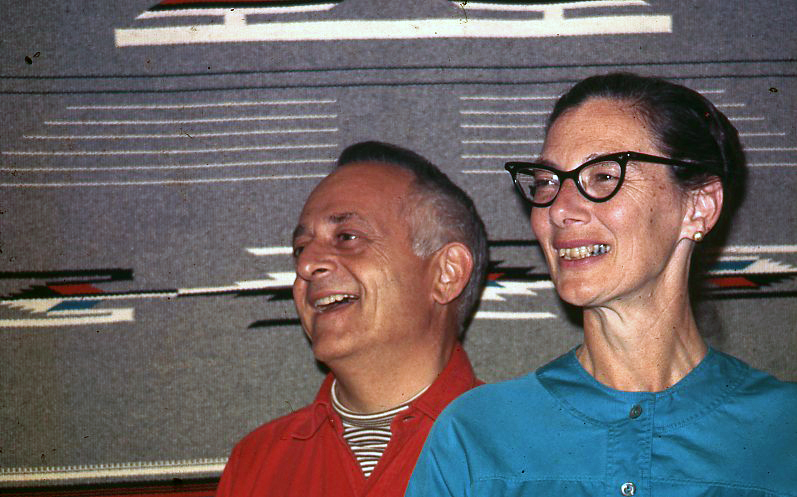
She found a way to balance Duncan’s needs (maybe more so than her daughter’s) with her artistic ambitions in a way that might shock women of my generation. She and Duncan agreed to an open marriage during the most stressful years of child-rearing (one of her daughters also had schizophrenia) and instead kept an emotional fidelity through those troubled times as well as the decades when their marriage was more conventional. They were a month short of their 60th wedding anniversary when Duncan died. Byrne always told her own daughters, and many others she “adopted” along her amazing journey, that a woman should never try to be everything to a man.
“There will always be a woman more beautiful, or more witty, or more sophisticated than you,” she told us all. “Which is why it is insane to try and be all of those things at any given time. Just trust that the right man can’t live without the unique combination of traits that define you.”
Hang on, I’m getting to a parallel to the work/life balance struggle that Slaughter points out keeps mothers from rising to the most powerful jobs in this country today. Courageous women like her try to be everything to everyone – especially to their children. Byrne would argue it can’t be done; I would add that it isn’t as necessary as societal pressure makes it seem. Mothers, just like fathers, don’t have to be at every recital, put band-aids on every boo-boo and home-cook every meal for their children to turn into functional, happy adults. Women who feel compelled to be super-moms as well as super-achievers in a competitive workplace have contributed to a generation of young adults who have never been allowed to fail, who have never had to fend for themselves.
Or, worse yet, have never had the experience I had with Byrne Miller. She became a second mother to me, one who expanded my horizons and filled different needs than my mother could. Slaughter’s own former boss Hillary Clinton might agree – it really does take a village to have it all.
From Limon, with love
If my memoir about Byrne Miller were a traditional biography, I’d be trolling through genealogy records to trace her roots. But Byrne’s biological ancestry is less important to me than her dance heritage – so I bought a ticket to see the Jose Limon dance company in New York last week.

The New York Times reviewer didn’t seem impressed, but I know with utter certainty that Byrne would have given him an earful. She reviewed dozens of performances by dancers (she was tough, once calling Pilobolus “boring”)and the NYT reviewer missed all the aspects that she would have found so powerful in Limon’s work. The dancers were hypnotically rhythmic and understated – they aren’t actors, they let the steps lead to a story. Byrne once said she feared modern dance was becoming too athletic – that the artistry was being lost. In Jose Limon’s legacy company, she can rest in peace. The dancers are strong but never overpowering; they work the floor as much as the air above it.
A woman danced the piece Jose Limon created for himself, the 1942 “Chaconne,” set to Bach’s Partita No. 2 in D minor for unaccompanied violin, and she was restrained in her power and expression because he was. She even wore men’s clothing. It wasn’t about her interpretation of his choreography; she was giving the audience the gift of time travel. I saw in her the connections Byrne once made. I stood up cheering wildly, just like the rest of the audience, when she took her formal bow at the waist – she was accepting appreciation for his work as much as hers.
In Limon’s choreography, I see Byrne’s inspiration and an eerily similar path to dance. Byrne started out training to be a classical pianist and was sucked into the vortex of dance when she saw Harald Kreutzberg perform an opening act for a Saturday matinée in the 1920s. The same thing happened to the Mexican painter Jose Limon; he saw Harald and gave over his life to dance.
Though I have no evidence that Byrne’s and Limon’s paths directly crossed, they share another pivotal connection. The handsome German dancer Lucas Hoving gave up ballet to dance for the company Limon eventually founded, and Byrne ended up being the principal dancer in the company Lucas Hoving eventually created in Connecticut. It’s like that in dance – the students become the teachers, the protégé’s add to the body of knowledge and transcend it. Byrne Miller certainly did her part.
Finding Byrne in New York
Greetings from about a mile from where Byrne and Duncan shared their first apartment as a married couple. We’re here in Manhattan doing a little research into Byrne’s early years. I’m working on a new rewrite – with my wonderful editor Susan Kammeraad-Campbell of Joggling Board Press. I’m trying to get inside Byrne’s point of view, rather than recount the stories she told me and other “adopted” children.
So I’ve poured over all the notes and journal entries she left behind, concentrating on the little things that never made grand stories on her porch in Beaufort. Like the first crush she ever had…on a German modern dancer named Harald Kreutzberg. She wrote him fan letters and was desperate that her mother never find out because he was that outrageous. That’s him – on the reel-to-reel screen behind me at the NY Public Library for the Performing Arts in Lincoln Center. He performed his “expressionism” in opening acts on the stages where Byrne would watch Saturday matinees. I’d seen pictures of him on the internet – wild, theatrical portraits that today seem vaguely homoerotic but probably weren’t then. Photos, though, can’t touch the impact of actually seeing him move. This was a dancer I would swoon over – so strange to find an almost childish connection to Byrne eleven years after she left us but there you have it. I only wish I could record some of the films and share them with you all…but it’ll be my job, and my delight…to think of the words to transport you. Wish me luck!

On admiring pharmaceuticals in London


Hours waiting at customs, TSA officials looking at see-through body scans of your junk, schlepping cases of photo gear around corporate offices – all of this is the decidedly non-glamorous side of producing corporate videos. But when you have a Sunday off in London and get to see the hottest new exhibit at the Tate Modern – it’s hard to beat. Hence my photographic homage to Damien Hirst above – on the left: his life-size pharmacy room and on the right: me on location at the corporate headquarters of the health care company we were shooting. Not bad eh?
Admittedly, Hirst’s “Pharmacy” was not one of the highpoints of his retrospective. The art speak goes “coloured liquids representing the four elements of earth, air, fire and water – suggesting the palliative power of modern medicine.” Whatever. Hirst himself is a little more honest about it: “You can only cure people for so long and then they’re going to die anyway.”
I knew I’d be shocked and awed by the outrageous Hirst pieces – the shark suspended in a tank, the stained glass windows made of butterfly wings, the severed head of a cow designed to grow maggots etc. I didn’t expect to be as moved as I was by his series of stainless steel cabinets containing facsimile pills – each one individually produced to replicate actual medicine. They’re beautiful, set against the mirrored background that forces you to see yourself in the pills we all consume.
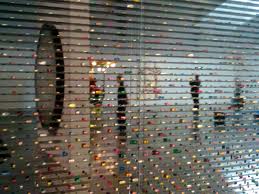
Hirst made all the other contemporary, conceptual art at the Tate look like art-school projects, and high school art school projects at that. Check out the video tour (it’s worth the commercial at the head) to see how big this guy thinks. http://arrestedmotion.com/2012/04/videos-damien-hirst-retrospective-tate-modern/
I complain about Gary’s collection of dead things he photographs, but at least we don’t have a wall-sized disc of black flies or a wall dripping with butterfly-hatching goo. Maybe that’s why I loved the video on the bottom floor of the Tate where Hirst recalls his mother saying, “Oh for the love of God,” every time he started a new project. It’s the title of the centerpiece in the show: the diamond-encrusted human skull. If only I could get Gary to start lining all of his deer jaws with rubies or jade….

Eat Soft Shell Crabs, then come listen to poetry
April is National Poetry month so this Saturday Otram Slabess will be staging our annual outdoor poetry reading at the Charles St. Gallery. I know, I know, there’s a lot going on in Beaufort this weekend. All the more reason to take a time-out at three in the afternoon and let the metered words of some wonderful writers soothe your hurried soul. Trust me, standing in line for an hour for an over-priced soft shell crab in Port Royal will make you crave a glass of wine, a chair, and the artistic shade of Lyals and Georgia’s gallery garden.
Before we open up the microphone, each Otram Slabess member (founders Warren Slesinger and Quitman Marshall, plus Steve Johnson, Jacquelyn Markham, Karen Peluso and me) will read a piece they’ve written, and one by a poet from the larger universe. I don’t know which I’m looking forward to more – my fellow writers are so accomplished and lyrical and entertaining that I joined the group just to hear their works in progress every month. I don’t even write poetry, but I love how these part-time teachers, publishers, parents and artists tangle with thoughts and words and even commas. They don’t make a living off of their poems (oh unjust world) but poetry is what grounds and inspires them. To listen to them read their own work is an invitation to see the world as they do. To hear them read their muses is an interior window and just as revealing.
I’m going to be reading a poem by Starkey Flythe, an award-winning South Carolina poet who spoke at a meeting of the Poetry Society of SC in Beaufort this February which Warren and Quitman hosted and arranged. He’s a brilliant and funny octogenarian; he advised the poets in attendance to have their portraits taken while they are young and said that education is meant to bore children to death at great expense. I find his poems as charming as he is, yet for the workshop he had us read poems about defacing graves and wrestling angels. His point was that poetry is more than rhymes of love and odes to azaleas. He encourages writers to tackle not the grand but the intimate.
Which is why I love the annual Otram Slabess poetry reading at the Charles St. Galley. It’s intimate. In Lyal’s garden you are close enough to jasmine to get drunk on it, you sit near enough to your neighbors to see what poems make them smile or cry or both at the same time.
To get you in the mood for Saturday, I highly recommend subscribing to a free email/facebook/twitter offering by Knopf Poetry. Every day in April, and we still have a few, they’ll send you a wonderful poem by known or emerging star in the world of poetry. You can friend or follow them, or try the e:mail address that appears in my mailbox everyday:
knopfpoetry@information.randomhouse.com
See you Saturday!
Selling the South in 90 Seconds
I’m a native Oregonian. I gagged the first time I tried boiled peanuts. When I applied for my first TV job, I honestly couldn’t point out South Carolina from Alabama on a map. And yet here I am, wooing Hollywood execs on Southern Charm. At least my take on it, a la “The Wedding Photographer,” the romantic comedy I started pitching at a festival last weekend in LA. My logline (the three sentences you’d read on the Netflix envelope if it gets made) goes like this:
When his own picture-perfect wedding proposal is rejected, a hip Chicago studio photographer tries to cure himself of romance by shooting a season of weddings in the Deep South. Think hair-of-the-dog, but for saps. He doesn’t count on falling for the one bridesmaid who calls his bluff.
What was a blast was explaining how the script makes you fall in love with the South as much as any one character. I told them that it’s a lushly beautiful setting, quirky and inherently romantic. That nothing matters more than family, tradition and love. Of course I let it slip that when the hero hooks up with the girl – skinny-dipping in a tidal creek filled with bioluminescence – it’ll do for this movie generation what “Ghost” did for throwing pots or “Dirty Dancing” did for learning to dance on a log in a lake. The reaction was good – of the 33 producers I pitched, all but three asked for my one-sheet (the faux movie poster by Paul Nurnberg starring Jenny Rone and Todd Wood). Seven asked to read the script right off the bat – which sounds great until I realized I have no idea if they have two dimes to rub together.

Those of you who follow this blog know these pitch festivals are like speed dating. Only this one, InkTip, is speed group dating. You stumble around a convention ballroom, squinting up at tiny signs indicating which productions companies are looking for your genre. There are usually three or four companies per table, but of course the one you’re really interested in never shows so you end up pitching to companies you’ve never heard of. My favorites, just going by the crazy names, were Bugeater Films, Clownfish Productions and Purple Octopus Inc. I decided against pitching ShoeZart inc, apparently known for the film “Scorpio Men on Prozac” and Weirdsmobile Productions who wanted Sci-fi in the vein of their other film, “Chastity Bites.” Can’t see either of those wanting to shoot a romantic comedy in Beaufort, can you?

It’s PG-13 – I swear!

I had the bright idea to fill my Career Day time slot at St. Helena Elementary by having kids stand up and read a few scenes of my latest screenplay, “The Wedding Photographer,” in character. What better way to introduce them to the world of writers? Fourth graders, I figured, have strong enough reading skills and self-confidence that I’d have no trouble finding volunteers to play the roles of Dillon (the protagonist) Sheila (his mother) and Sienna (his girlfriend). They loved it but it turns out they can read faster than I expected. One little girl flipped right past my carefully selected scenes.
“Miss Teresa,” she politely called out, “there’s a bad word at the beginning of the middle part.”
“Must be a typo,” was my lame response as I quickly gathered up the scripts to head to my second session: Mrs. Washington’s second grade class.
I asked the teacher to select the strongest readers since I wasn’t sure if they’d know how to pronounce all the words. They were all excited, except for the girl assigned to play Dillon’s girlfriend. Turns out in real life, she hates the boy picked to read Dillon’s role and was mortified even to stand next to him. But when she realized her scene involved turning down his wedding proposal, out came the hip, the lip and the loudest voice you can imagine.
“I’m sure it (the ring) fits,” she snarked, “It’s just you and I – don’t.”
The whole class howled with laughter. And according to my first official focus group of under-18-year-olds, I’m golden. If only I could take them all with me out to LA this week to help me sell “The Wedding Photographer.”
South African Artist at SCAD deFine Art
The ultra-modern design of the new art museum at SCAD was reason enough to make a trip to Savannah over the weekend. I had no idea that there was an exhibit by the renowned South African sculptor Jane Alexander; it was just a happy accident. I haven’t been as unmoved by a museum exhibit since stumbling onto a Thornton Dial retrospective in Indiana last year. I say unmoved, because in both cases I simply stood there, transfixed. With Dial, I instantly recognized a witness to the South’s despair and disparities. When I saw Alexander’s creepy, life-sized “humanimals” my feet felt cemented, weighed down by a deep connection and unease I still don’t really understand.

I suppose in the case of her “Surveys from the Cape of Good Hope” the connection is the childhood I spent in South Africa. Like Alexander, I grew up a treasured white girl in a country that still embraced Apartheid. Unlike her, I have never found a way to express the myriad of ways that system both shaped and shamed me.
Although Alexander is famously reticent about the “meaning” of her work, I sense this exhibit is her way. There are no pamphlets full of art-speak. The walls have no explanatory paragraphs. Even the titles of the pieces are enigmatic; I didn’t know what “Bom Boys” meant until I scoured the internet. Gary loves this kind of freedom to interpret art (he can’t stand even naming his photographs for exhibitions) but I need context. So for me the eager student docents positioned like ambassadors at every turn were actually useful. The young man who kindly noticed my inability to just move along had clearly gone through something similar himself. His role, his relief perhaps, was to share everything he had learned about the stories behind each piece.
Before I realized it, my feet were working again. Maybe his enthusiasm was just a factor of the museum’s newness. Maybe he was earning extra credit or fulfilling a work study obligation. But I’d like to think it was transcendent, connective power of art.
What I really won at BIFF
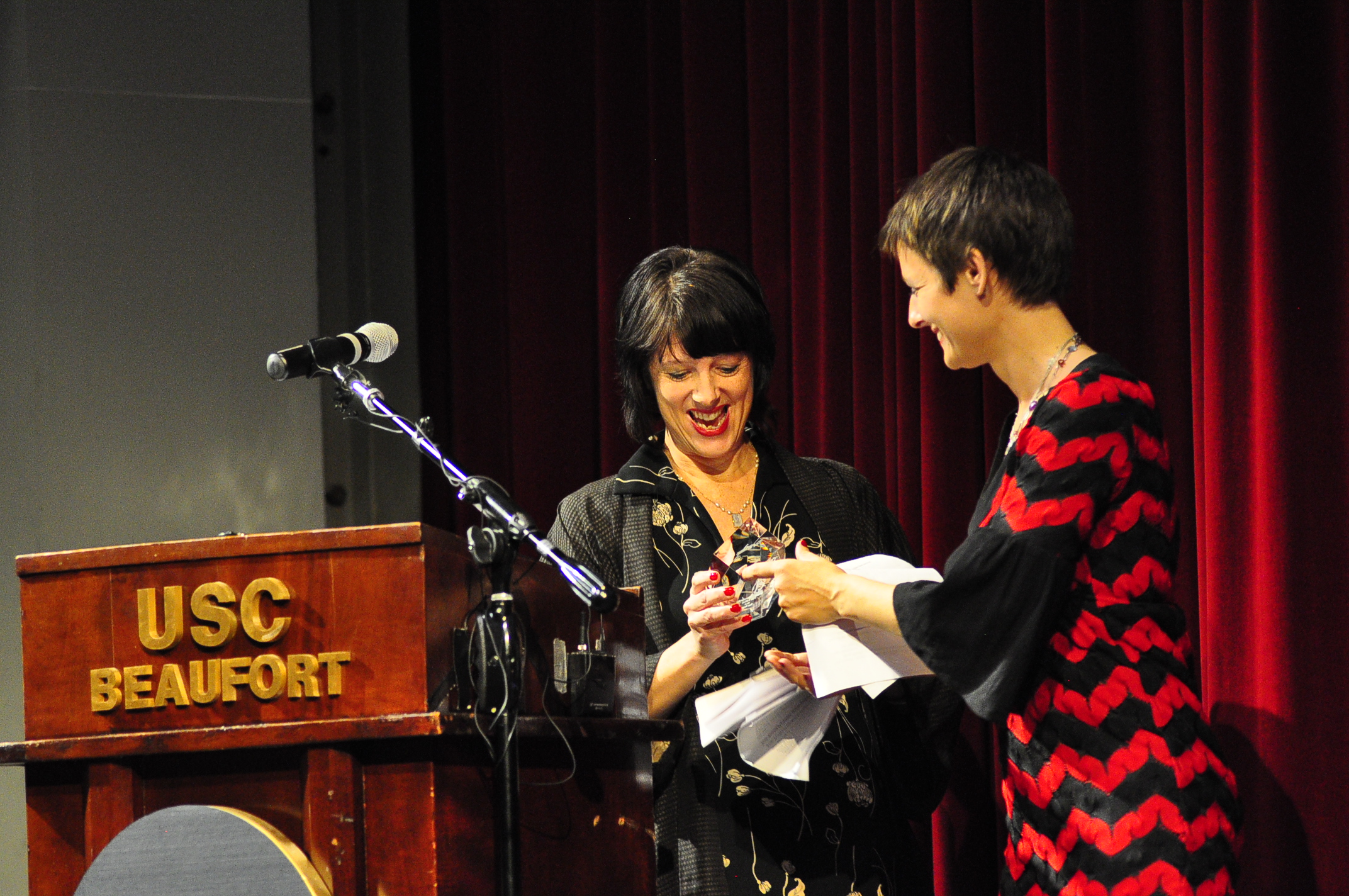
A week ago today I got to hear an excerpt of my latest screenplay on stage for the first time – at the Beaufort International Film Festival screenwriting finalist’s table read. I knew the staged reading of “The Wedding Photographer” would go better than last year’s screenplay when even a scene description got a belly laugh from the audience. I had the crowd at “Interior – Harold’s Country Club – night.”
Part of that is due to the fact that admission included wine – and lots of it. But mostly it’s because we all love to hear a love story about people and places we know. My job for the rewrite is to make the story resonate beyond Beaufort, to audiences with no idea why a wedding at Harold’s Country Club is funny. And I found fresh inspiration from an honoree much more deserving than me: the academy-award winning film editor Craig McKay.

I thought I knew his work – blockbusters like “Silence of the Lambs,” “Reds” and “Philadelphia.” But it was during the workshop he gave at BIFF that I learned he edited what I consider the best coming-of-age movie ever: “Sin Nombre.” It’s a gritty, low-budget, independent film about immigration that thrusts you into the beauty and pain of life. You’d swear the same person both shot and edited the film – the end result is so rushing, fluid, surprising and lingering. After listening to McKay describe his work, I realized he’s the visual equivalent of a poet. There’s a rhythm to every decision he makes in the edit suite, a conciseness that only appears spontaneous. He simply calls it storytelling.
“Hollywood had its worst year ever last year,” McKay told the audience at USCB when he accepted his Jean Ribaut award for excellence in film editing. “They stopped telling stories.” Luckily for me and countless others starting out in this business, McKay hasn’t. He really believes independent film is the future, that without the scripts and shorts and features competing for audiences at film festivals like Beaufort’s, audiences would stop coming to the movies.
So he told stories during the workshop. He told them during his humble acceptance speech and he told them at after-parties where everyone else was schmoozing or celebrating. He is the kind of guy I felt comfortable asking how and when to break the linear timeline in a script. I asked because so many movies start in the middle or at the end, tumble through out-of-sequence back stories and leave the viewer scrambling to figure out where the story starts. I wasn’t expecting his answer.
“Most of the time it’s to cover up a bad story,” he said. He was far too gracious and smart to give examples. He still edits two or three movies a year, between producing his own humanitarian documentaries. “But when it is planned it can be brilliant. Be clear about what you’re doing but don’t give away what is still to come.”
I’m still editing that inside my head.
 "TeresaBruceBooks"