travel
Coon Dog Cemetery

You know that point on every awesome road trip, when you decide to squeeze in just one more sight and the whole thing gets bogged down? Well that point was Muscle Shoals, Alabama for us. After the Tupelo, Oxford and the Delta…it was pushing our luck to try and swing through the OTHER Southern music landmark on the way home. But I’d heard about Muscle Shoals on NPR’s American Roots and just had to try. Turns out there’s an Alabama Music Hall of Fame there but it’s a squat, uninviting building off the highway with too many retirement home tour buses in its parking lot. The famous “Fame” Recording Studio (a Cher album cover, anyone?) was equally disappointing, penned in by fast food and pawn shops. We couldn’t even find a downtown Muscle Shoals to celebrate – just endless loops of roads that look a lot like Highway 21 entering Beaufort.
What saved Muscle Shoals was actually about a half hour into the mountains – the world’s only coon dog cemetery. There’s evidence of hunting dogs all along the winding road – the kind of evidence that makes you glad you’re not a coon dog. Think trailers with cages outside in the snow and that’s the type of reverence shown coon dogs when they’re alive. But when a good hunting dog dies in Alabama, its owner gets downright sentimental. I figured on simple, homemade crosses, maybe the odd gravestone marking faithful Fido.
But at the Coon Dog Cemetery, there are tombstones and even statues penned in by barbed wire so no one steals the cement raccoons chased by the everlasting enshrined dogs. The names alone are worth a leisurely stroll through the wooded cemetery – Troop was apparently the first but not the last.
These are not dogs, or dog owners, to be messed with. On the long mountain road back, we passed a no trespassing sign. It read “Nothing I’ve got is worth you getting shot for.” I just know there were coon dogs out back.

Call me Sweet T
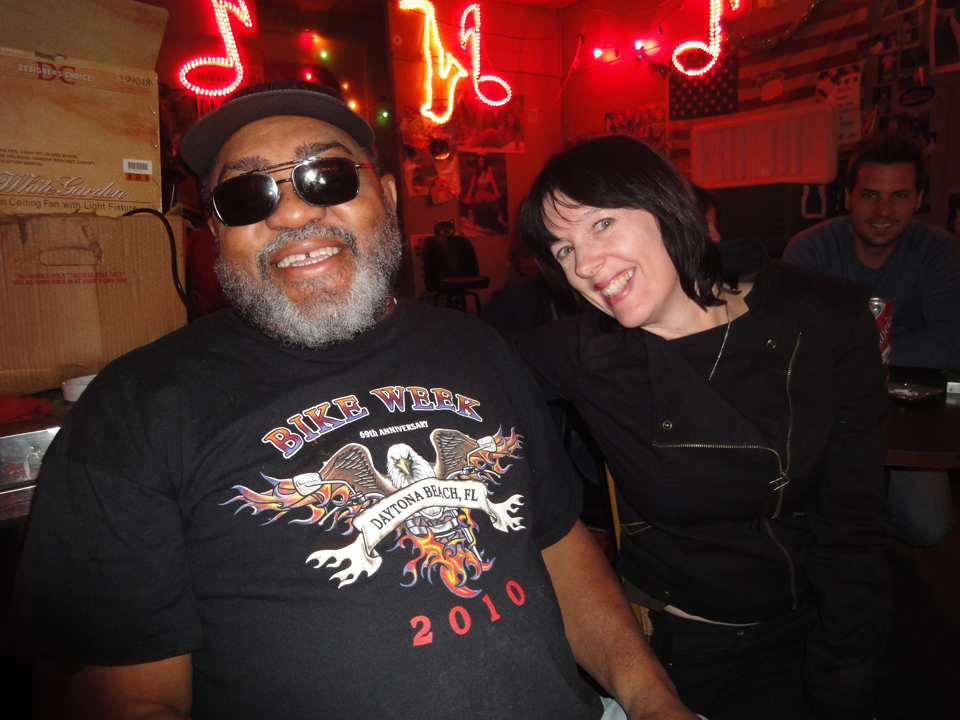
That’s my new blues name. Everyone we met in Mississippi gave themselves a name, so why not me? Blues names are different from nicknames – the kind you get stuck with, like toilet paper on the bottom of your shoe. They’re conscious, self-selected and meant to get conversations started.
As soon as his set at Morgan Freeman’s Ground Zero blues club was over, the host – a tall, thin man named Razorblade – sat down next to us at the bar. Within minutes he told us that he calls himself Razorblade because he’s a sharp dresser. His wife, who wasn’t there, makes sure he’s put together proper before he goes on stage. On the night in question, he was wearing a gold suit with a purple t-shirt. Razorblade also told us that Red’s, a juke joint down the street, would be hopping the next night.
Red, of Red’s fame, is not a redhead. And he did not volunteer the source of his name. But he did tell us to pull a chair up to the space heater when we arrived at his club. There were only five customers at nine o’clock that night; Red’s doesn’t get going until later. Which explained why it looked abandoned when I knocked on the door – sofas outside on the sidewalk getting rained on, windows boarded up.
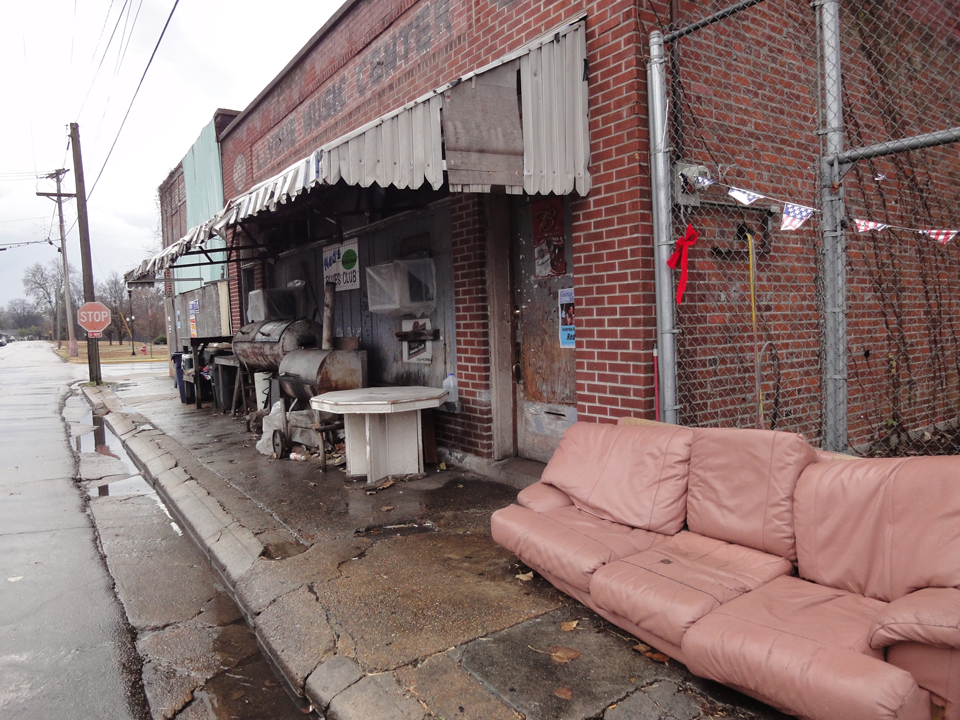
Red’s is the kind of place that, the minute you enter, you start sizing up your escape route should there be a fire. Which isn’t that far-fetched. I did pull up a chair next to Red, but the space heater’s pilot light shot straight out, horizontally, so I kept a nervous eye on it all night.
Gary forgot all about fire hazards when a man named Dingo offered to share a bottle of Christian Brother’s brandy. It was too big to hide in a paper bag, like all the other liquor being poured into plastic cups at Red’s that night. Turns out Dingo picked his name on account of the boots – which he always wears. Another sharp dresser, and a good dancer too.
He introduced us to Watermelon Slim, whose name was instantly understandable. He’s played with the likes of Bonnie Raitt but is just as enthusiastic to sit in with the bar band at Red’s: the All Night Long Blues Band. Not at all pretentious, he shouted out a welcome to his new friends from Beaufort, South Carolina when he pulled out his slide guitar. Just before he leaned into the microphone to say he’s been to South Carolina a couple of times. “Liked it enough. Just never had a chance to piss there.”
The best name of the night had to belong to the hottest bass player in all of Clarksdale. Just as it’s a good thing codes enforcement doesn’t seem to exist in Mississippi, it’s a good thing cops don’t frequent juke joints. Because then magical moments like listening to Kingfish sit in with the All Night Blues Band wouldn’t happen. He couldn’t have been five feet tall and when I asked Dingo how old the kid was, he guessed thirteen. I wanted to take him home with me. Dingo asked me if I was sure; he’d eat me out of house and home.
Let’s just say Kingfish didn’t get his name because he’s bird-like in any way. Nor does he yet have the stage presence of B.B. King or Watermelon Slim. But he made the audience put down their Christian Brother’s brandy and listen. The kid’s that amazing. After he played a few songs, Dingo told him the gal from South Carolina wants to know how old he was. I could hear his answer clear over at the space heater. “Eleven. Sir.” And then he had to go home.
Blues Landscape

When we set out for a Mississippi Blues Highway road trip this winter, it’s not like I was expecting the “Summertime,” and the livin’-is-easy version of the Deep South. You know — fish are jumping and the cotton is high and all that. I knew the Mississippi Delta would have a rough kind of beauty, if at all, which is exactly why Gary wanted to photograph it for his project (http://carrymehomeproject.blogspot.com)
I just wasn’t ready for images like this one: a sharecropper’s shack on Highway 1 just south of where Muddy Waters was born. We found it on a day that didn’t get past 16 degrees. The wind whipped through my bones and I can’t imagine what it must have been like to live inside this home – winter or summer – never making enough money to move away. You couldn’t even make a run for it. The fields around it are ankle-breaking troughs of defoliated cotton plants. The horizon is so flat and far away you might as well be adrift at sea.
Which is how I felt, driving through this landscape of leftovers. It might be prettier when the cotton is high, but after the harvest the fields look like the stubble of a cheap shave. Plastic Wal-Mart bags catch and snare on stumps – pockets of trash biding their time, flying the colors of the poor. The dirt roads beat down hard here, cutting through the flatness like scars. Even the trees are stripped, nakedly twisting in the wind.
I’ve seen this kind of forgotten before, on our drive through the Altiplano of Bolivia and Peru. That Mississippi is our own corner of the Third World was no surprise, witness Hurricane Katrina. What did surprise me, threw me really, was the hope that floated up between waves of despair. Here in the Mississippi Delta, where the human spirit had every right to sink, it didn’t. People had the strength to shout it out – from back porches, on curbs outside gas stations, in Devil-guarded crossroads and under the cover of dimly-lit juke joints. They gave voice to what would have been a void. They freed what could not be stolen. Mississippi Delta Blues was a gift to the entire world. We, who didn’t even ask, got Robert Johnson, Muddy Waters, Elvis, Sam Cooke, John Lee Hooker, B.B. King and countless others.
This embarrassment of talent is no coincidence. But it has as much to do with the will of the tree growing up through that sharecropper shack on the side of Highway One as the misery of the shack itself. We do learn from those who went before. I don’t remember Byrne Miller ever quoting Blues lyrics, but her favorite Nietzsche saying would be right at home in the Delta. “Life is hard to bear. But do not affect to be so delicate. We are all of us fine sumpter asses and asseses.” Beasts of burden – yes, we surely are. Capable of so much more — uh huh.
The Riverside Hotel and Robert Nighthawk’s suitcase
Tupelo, Mississippi is the kind of town that looks lovelier at night, or under a light dusting of snow. Clarksdale, just two hours west, can’t be camouflaged. Its buildings have no heft, no angles to soften or drape. They’re mostly abandoned, sagging and scraping the streets, as dismal at dusk as dawn.
But even Clarksdale is glamorous compared to Friar’s Point. A levee-side view of the Mississippi River and an official marker on the Blues Trail try, but fail to lift its spirits. It’s a mean kind of ugly, boarded up and half burned down just for spite. It boasts a museum that isn’t open for visitors and a son who couldn’t run away from it fast enough – blues legend Robert Nighthawk.
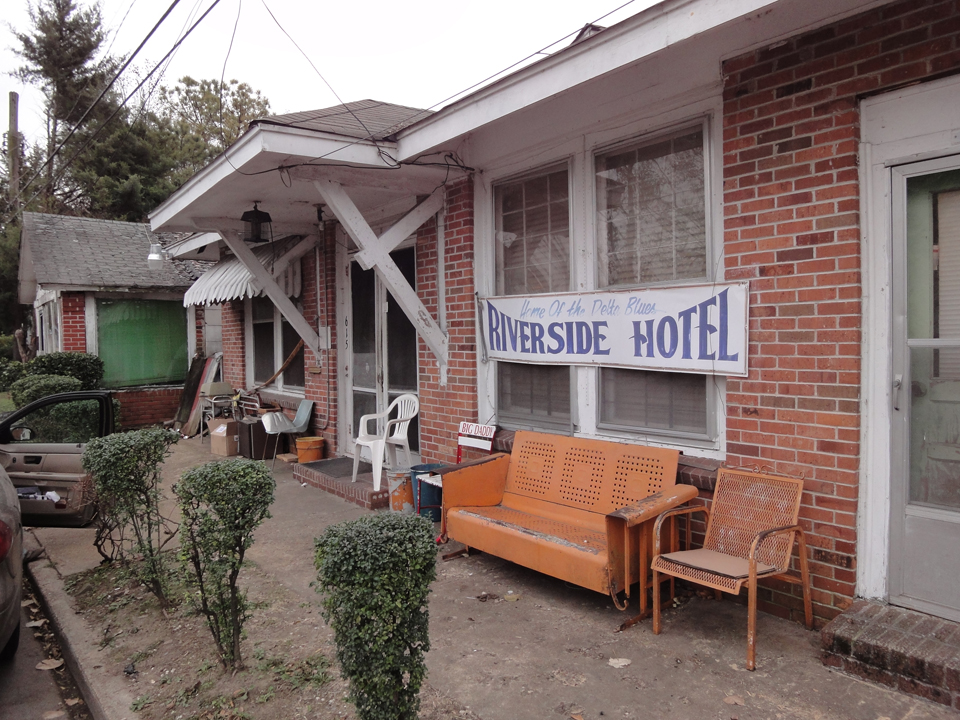
He was in such a hurry to get to Chicago that he left his suitcase at the train station back in Clarksdale. A man named Rat still has it. He runs a hotel called Riverside, where Nighthawk spent his last night before the journey that would end in relative fame.
Rat’s mother owned it back then. She’s the one who thought of turning the old black hospital in Clarksdale into a boarding house. It went from being known as the place where Bessie Smith died after her car crash, to the place where just about every blues musician on the circuit stayed. From Muddy Waters to the Blind Boys of Alabama, the greats made the Riverside their home away from home. Some still do – twice a year when the town’s juke joints swell with blues festivals. Regulars leave their personal items in the drawers of the well-worn bureaus in each room. When they come back, their stuff’s still waiting for them.
Well, except for Robert Nighthawk. When he came back, Rat’s mother couldn’t remember where she had stashed away his suitcase for safe keeping. It was only after they both died that Rat found it. It’s in the back room now, just in case the spirit of Nighthawk ever pays a visit.
Shackin’ Up
Shackin’ up sounds much racier now that I’m married than it did when I was doing it for real. Back then my reasons ranged (depending on the boyfriend) from saving rent to playing house, secretly hoping for the real thing. I even shacked up with (gasp) a woman: Byrne Miller. Luckily my scandalous past didn’t deter my Duncan, when I eventually found my perfect traveling companion. So when a friend who knew we were taking a Mississippi Blues Highway road trip suggested we stay at the Shack Up Inn, I wasn’t hard to convince.
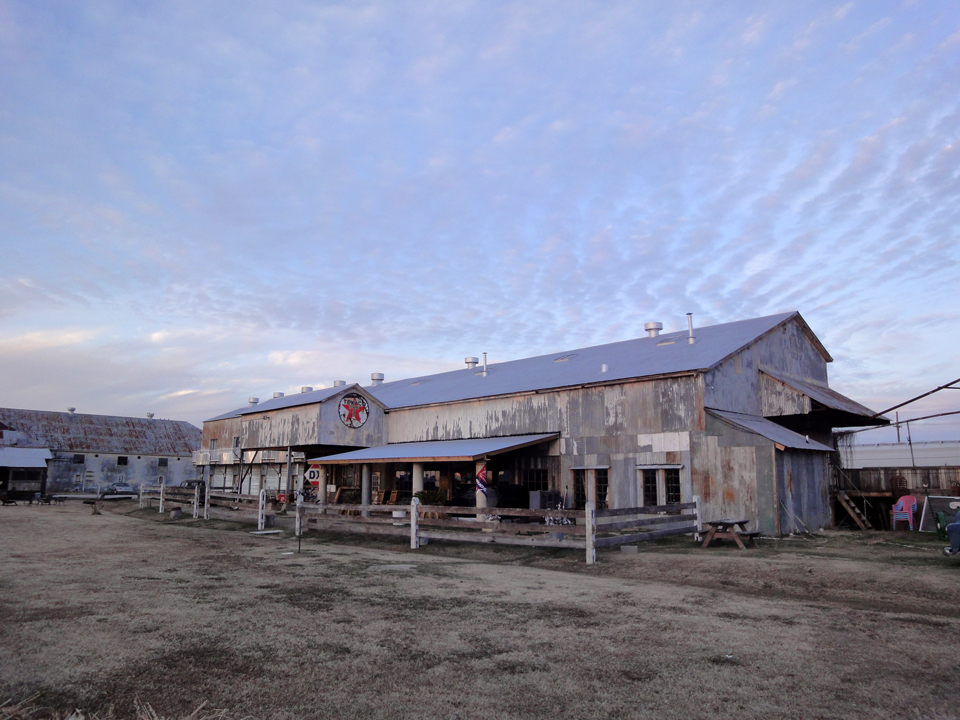
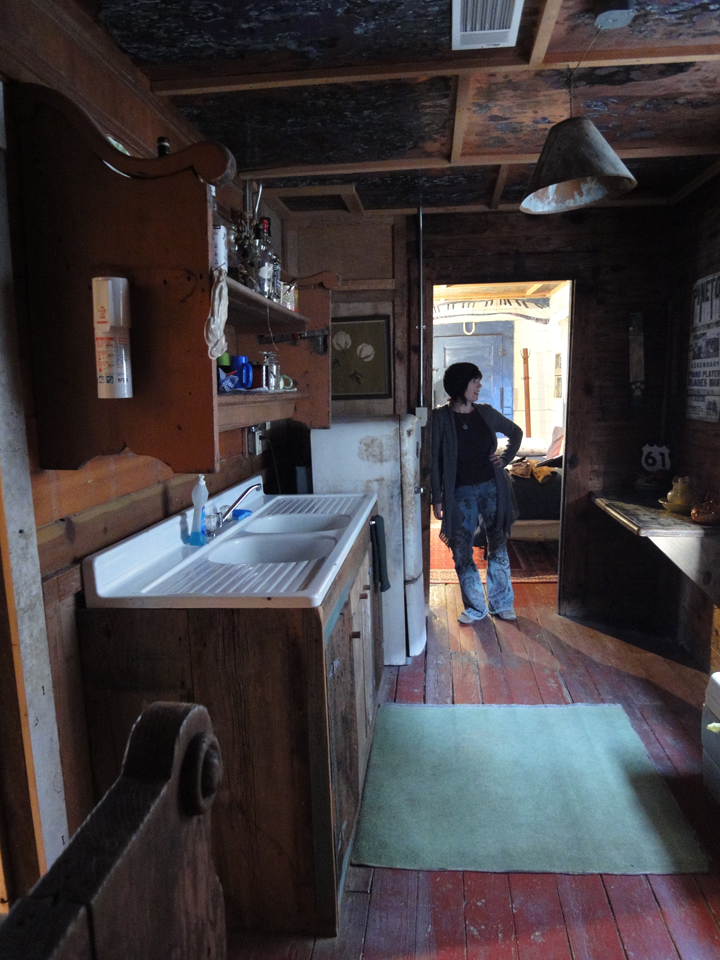
The Shack Up Inn is actually an old cotton plantation (Hopson) where Pinetop Perkins once drove tractor. It’s just up the highway from the crossroads of 61&49, of Robert Johnson fame. When the mechanised cotton gin ate up all the miserable jobs, there were plenty of sharecropper shacks available dirt cheap. So now a string of them sits behind the cotton gin, rented by the night by mostly white, European blues lovers. Or just lovers. Ours was the Pinetop shack – a porch, bedroom and living room complete with piano.
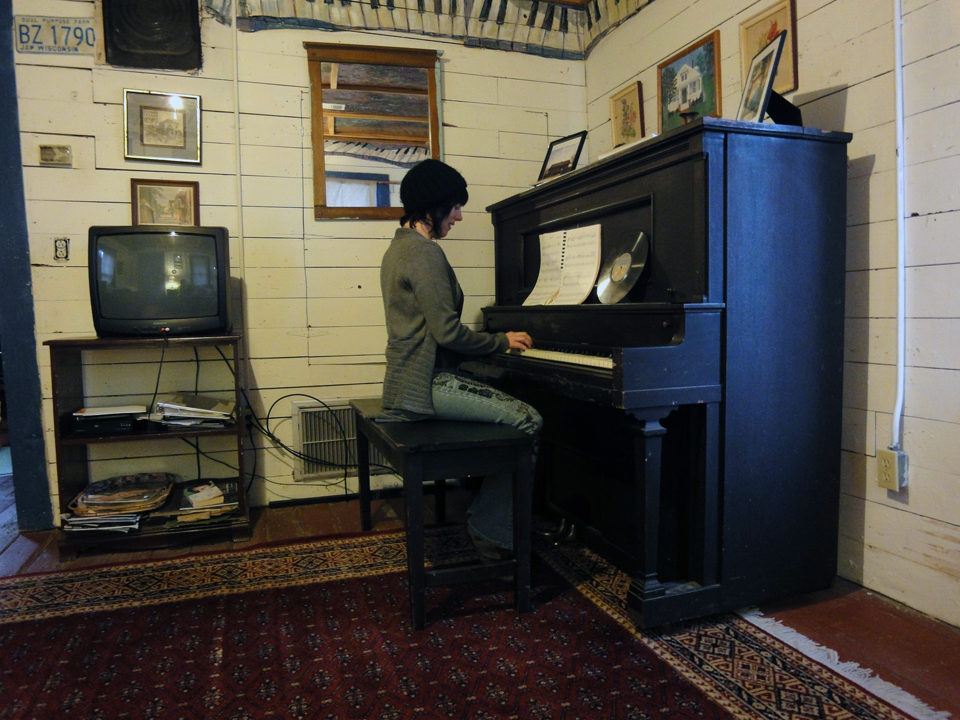
Why did I give my mother so much lip when she tried to teach me to play? And why didn’t I know about the Shack Up Inn when Byrne was still alive? She was on her way to becoming a concert pianist when a salacious casting director saw her lanky legs and luscious curves. You could say she sold her soul to the devil, if you were looking for segues to Clarksdale, Mississippi.
Maybe next time I shack up in Pinetop’s shack I’ll write a blues song about it.
Christmas with Elvis
 Christmas in the Deep South is colder than I once promised a certain someone, to lure him into moving here. Much colder. And without the charm of a light dusting of snow to get you in the spirit. For a secular humanist, I do try. But even with a tree dancing with ornaments in the front room, our house is lacking in Christmas tradition.
This Christmaslessness has a history. Byrne and Duncan, both Jewish, lived here since 1969. When I lived with her, after Duncan died, the most Yuletide-y it got around here was the Nutcracker ballet. Which, frankly, we both hated and suffered through simply to keep the Byrne Miller Dance Theatre in the black.
So heading deeper south to ring in the season made as much sense as sitting around Beaufort waiting for it to snow. Winter is a great road trip season, if you don’t mind plenty of parking (and free) in every town. In 2,000 miles we didn’t run into any other tourists, except for a young couple from Vienna. So we had Elvis to ourselves.
His birthplace, that is. Worlds away from the tourist-mecca of Graceland is the two room wood house in Tupelo that started it all. A mile up the main drag is the hardware store (still a hardware store) where his mother talked him out of a rifle and bought him his first guitar instead.
The house is surrounded by a museum now, and a fancy park. But it’s the stark reality of seeing the humble beginnings of a star that made this visit the best way to get into the spirit.
I think I’ll go put on my Elvis sings Christmas CD – glad to be home by Christmas afterall.
The fish that got away

My family is still stunned. I caught a fish. A huge fish. A Redfish so big I had to put it back. For those of you who read my blog on “Why fishing is nothing like dancing” earlier this year, brace yourself.
My friend Terry Stone did not do the work for me this time. He did drive the boat. Loaned me a real reel and hinted that I’d have better luck casting in the lee of a nearby oyster bank than in the middle of Station Creek. But that’s it, I swear. I baited the hook myself, casted without impaling anyone else on the boat and all by myself, wrestled it from the waters of the Port Royal Sound.
Well, I did have a little help. From Martha Graham. Years of modern dance training finally paid off. When a fish that size hits your bait, it feels like your wrists will snap. Whiplash is not out of the question. Girly girliness is. Luckily I had strong enough thighs to grip the freeboard and not fall overboard. I instinctively pulled into a Martha Graham contraction – back rounded, stomach clenched, thighs engaged, neck taut – and got me a fish!
It’s hard to believe I was once a vegetarian. The teen-me would have cheered for the fish to win the fight we had in Station Creek. But the adult-me had no such qualms. That Redfish and I were absolute equals, despite me weighing six times as much. She, and I’m sure it was a she, knew the waters better, had more to lose than I did and probably better instincts. Well, except for the part where she bit down on a half-dead minnow impaled on a sharp hook. I like to think I wouldn’t have done that.
The adrenaline rush was as powerful as I’ve felt after any dance class. I’m sure that’s the only reason I let Terry talk me into sticking my hand through her gills to pose for his cell-phone photograph. Our battle wasn’t over. She clamped down on my hand like a vice, bone on bone. She defecated on my other hand, holding her up for the victory pose. And when we lowered her over the side of the boat to let her go, she didn’t stick around to thank me. In a silvery flash she left me – hooked.
My First Ice Hockey Game

I am plagiarizing my own guest blog today – it’s all my friend Audrey’s fault. She treated me and Gary to an NHL game in DC Friday, and was so amused at my sports naiveté that she asked me to write about it – for all of her sports fan followers (http://audsnanns.wordpress.com)
I must admit, I had my reservations about professional ice hockey. Audrey’s the sports geek in our kindred spirit-ship; I ask embarrassing questions like what sport do the Caps play? The last time I watched ice hockey, okay the only time, was the Miracle on Ice on Wide World of Sports. I won’t say how old I was, but let’s just say I wasn’t living in the South at the time. Now I am, and not a soul I know plays or watches ice hockey – for obvious climate-related reasons. People here value ice only for its ability to keep oysters, freshly-caught shrimp and cheap beer cold.
I realized this wasn’t reason enough to turn down Audrey’s invitation when we visited over Thanksgiving. Besides, I’m only a transplanted Southerner and so have no cultural immunity. Truthfully, it was the blood factor. On the continuum of imagined barbarity, ice-hockey is somewhere between vampire orgies and giving birth. All of which makes me queasy just writing about it. It’s not really my fault. I’ve fainted at the sight of blood ever since I had my ears pierced. It’s genetic. I passed out and so did my mother, right there at the jewelers counter. When I came too, she was bleeding, from a gash on the forehead where she collided with said jewelry counter on the way to the floor. I fainted again.
It doesn’t help that the Caps’ color is blood red, and entering the stadium/rink/arena (I really know nothing about sports) is like diving into a red-tide. My husband and I, dressed head-to-toe in black, must have looked like characters out of a Southern Goth novel. Half-frozen creatures out of our natural element, down to the gloves we wore for the entire game.
Which was nothing like what I imagined. Firstly, there was no blood. Not even when a Caps player mixed it up with a Tampa Bay bruiser for some infraction that happened far too quickly to justify. These guys pummeled each other, helmets off and spit flying, much to the delight of the crowd. The jumbo-tron provided a closer look – instant replay of anger mismanagement. If there had been blood, I couldn’t have avoided it. Instead, I got a glimpse of plumber crack disguised by tattoos. Maybe I should rethink my blood aversion.
The game itself was insanely fast and blissfully quiet. No annoying play-by-play to interfere with the occasionally creative curse hurled at the visiting team’s bench. It brought back memories of my childhood. I was so much smaller than my classmates that in grade school, boys humiliated me with taunts of “Bruce-flea” and “You’re too short to be a jockey!” I got to re-live these insults again, thanks to a height-challenged Tampa player named St. Louis. Now I realize that they’re funny.
So is the fact that half of the players don’t speak English and cede their post-game victory interviews to lesser, native-speaking players. Pronouncing their names requires a concentrated diplomacy of effort on behalf of their fans – something rarely conceded to ordinary immigrants. It isn’t easy. Even a transplanted Southern woman finds herself blushing when screaming the name of the hat-trick hero of the night. Semin! Semin! Semin! Audrey kept reminding me, “think semi-colon,” but that only made it worse.
In the end, I found myself enjoying the spectacle and abandon of the game. Even in politically correct DC, there was cussing and insulting and booing. In real life, it isn’t nice to gloat over the misfortunes of others, but in ice hockey it’s expected. The Caps didn’t just win, they shut out the sorry Southern team 6-0 with a hat trick to boot. And even though there was not a drop of blood in sight, I was giddy with it.
The minefields of meal memories
I’ve been thinking about the tenderness and tact required in discussing food that mothers made. As in years ago – when their children were growing up – the dishes we now remember with varying degrees of fondness. My mother admits she hates to cook. Which made her, in my estimation while growing up, the world’s worst cook and the reason I became a vegetarian for 20 years. Later I learned that she cooks with resentment – angry at the husband who won’t boil water and kids who absorbed the message that cooking was her responsibility and we didn’t have to help either. Eeesh – I’d slap myself if it would change things.
I’ve now discovered that my mother inherited this from her own mother. I’ve had the chance to spend more time with my grandmother than my mother lately, and food is not one of the high points. She was a career woman and fighting for labor rights was more important than making dinner for three kids. It was the fifties and that’s what TV dinners and a compliant daughters were for. I’m sure I would have agreed – back then. Now she gets insulted when I don’t eat the snacks she lays in for my visits (fig newtons, canned ham, ice cream, frosted Oreos) or the things she brings back as leftovers from her retirement home’s dining hall (half-eaten grilled cheese, for example. The dog is much more appreciative. And fatter.)
It’s not necessarily easier to maneuver through meal memories in homes with good cooks. My mother-in-law served three different veggies from her garden with every meal and made apple strudel her boys still wax rhapsodic about. But as she closes in on ninety, she doesn’t have that energy anymore. Or the necessity. It makes more sense to buy processed foods that come in sizes better adapted to reduced appetites. She too, feels slighted when her visiting kids ask for soy milk, non-fat yoghurt instead of sour cream, or less oil in the bean salad. “What’s wrong with what we always ate?” is the unspoken question. She just set the bar too high and now her boys are all amazing chefs with very particular palettes. It’s easy to solve, though. Her sons and daughters-in-law just make a big show of “treating” her to a home-cooked meal, in her own home. It’s the Wisconsin way to avoid conflicts.
Just when I get to shaking my head about all those old-timey, unhealthy recipes, I get a reminder that puts me in my place. When I was researching my last blog, about Byrne Miller’s famous soup, I ran across an article in “The Litchfield Hills Sampler” of Torrington Connecticut. That’s where Byrne was living, and teaching dance, in the summer of 1971 (to escape Beaufort’s heat three months a year.) It was titled, “Cooking with Love” and told the story of Byrne’s soup. The writer clearly wanted to include a recipe, but Byrne’s soup never had one. It changed with whatever was left in her fridge. So she printed another recipe from Byrne.
Glen Cove Bake
1 lb boiled ham, very thinly sliced/6 medium potatoes, boiled, sliced very thinly/8 hard cooked eggs, thinly sliced/1 1/2 pints sour cream/ salt, pepper, paprika.
The article went on to describe how you cube the ham and layer the ingredients in a buttered casserole dish. I was horrified. Byrne, what were you thinking? You were a dancer. Your body was your temple. And then I read on. “The last time the price of boiled ham was at a premium was during the depression in 1933, when the Millers were first married and living in Glen Cove, New York. ” Ouch. Okay. I get it. But I still don’t want to eat it.
Luckily I have no children of my own. So there will be no disgusted progeny to react, years later, to the papaya salad I served at our progression dinner this past weekend. And it comes with its own provenance. On our first trip to Laos, in 2001, Gary and I ordered the green papaya salad at a restaurant in Vientiane. The waiter made a face, told us it was very spicy, and we were as insulted as our mothers probably are with us. So when a small crowd gathered on the balcony above the dining courtyard, waiters and cook staff, we couldn’t back down. The papaya salad was ruthless. Fluids flowed from every facial orifice. Not enough water in the world would help. My face was crimson; Gary’s a curious salmon color. But we ate it. Defiantly. Needless to say, the recipe we served Saturday is quite toned down. But still only eaten by half our guests. See what you think.

Laotian Green Papaya Salad
1 green papaya – julienned
4 carrots – julienned
10 green long beans – julienned
1 garlic, 1 Thai chili, and 1 tablespoon each of shrimp paste, sugar, chicken bullion, fish sauce, lime juice and dried shrimp – all mortered and mixed into a thick drizzle that you toss with the papaya and carrots. Top with cherry tomatoes and roasted peanuts. Hand out handkerchiefs.
Remembering Soup
By the time I lived with Byrne, she had long-since parted ways with cooking. She re-heated. Unwrapped. Combined. Added Water. There was a phone call once, after I had moved to DC, comparing what we’d each had for dinner. Me, pizza from scratch by Gary. Byrne, oatmeal with sardines. But it wasn’t always so. In my research for the Byrne Miller Project, I ran across an article in a small Connecticut weekly extolling the dancer’s famous soup. It turns out it was rather famous. (In the blog about her birthday, Benjamin Barney left a comment you should read.) Basically, she started a huge pot of soup whenever a deadline loomed – a performance, or publication of a school magazine – and added something to it every time she walked past the stove. She said it was ready when a fork would stand up in it. It stewed for hours, even days, and everyone working on the deadline partook of the pot for sustenance.
I was thinking of this collective soup when I volunteered for the soup-and-salad portion of a progression dinner planned by my friend Jon. The guests/cooks were eight rather foodie types – not starving dancers or students – so I decided to try something a little less random. Okay a lot less random. Instead of chucking whatever was in my fridge into a pot, I made trips to five different stores. Terribly un-green, but there’s no choice when you live in Beaufort, SC and decide to make a green papaya salad and chilled coconut curried squash soup. At least the squash were local – from the farmer’s market Saturday morning. I’m not sure where the owner of Beaufort’s newest Asian food store (called Spout) gets his green papayas and nuclear Thai chili peppers. I’m guessing not from around here.
I’ll never know if the soup would have held up for days – our second course stop lasted only ninety minutes. But it was great the next day for lunch. I only wish Byrne could have tried a taste.

So now the recipe:

 "TeresaBruceBooks"