dance
One lover too many
I have two grandmothers whose memories are in varying stages of reliability. But every time one of them confuses a story, or calls me by another name, I remember one of my favorite stories about Byrne. It comes from one of my very closest sisters-by-Byrne, Lisa Lepionka.
Lisa was a tireless supporter of Byrne – she even kept tabs on Byrne’s daughter Alison until she died a few years ago. One of the many things Lisa did was help organize Byrne on concert days. Byrne herself would be juggling so many last minute details that if she didn’t have Lisa looking after her she might have arrived on stage having forgotten to dress. Not that that would have been a big thing – you’ve seen the photos of her.
One day, Lisa asked her then-teenage son Franz give Byrne a heads-up phone call, letting her know that Lisa was on her way to the house to pick Byrne up for the concert. It wasn’t until days later that she and Byrne had a chance to decompress and talk about the performance.
Lisa still laughs about it. Byrne told her “I had a lover once named Franz, and I had no idea why he called me last week.”
Cheers – to a life filled with so many lovers you occasionally mix them up.
The value of dance
I could never write a memoir about my relationship with Byrne Miller without the help of my sisters-by-Byrne: other women adopted into her extended family. Judean Drescher is a yoga teacher in Savannah, and she found her inspiration and confidence to teach through Byrne. Judean was one of Byrne’s longest-running students, suffering through cramped classes in the un-airconditioned YMCA building way back when it was a Quonset hut in Pigeon Point Park. She said what impressed her most was Byrne’s ability to create a safe place for intelligent women to express themselves physically.
“Everyone in the class was smart and accomplished. Marlene a successful architect, Lisa a teacher – but they weren’t dancers and in a typical class they would have felt insecure or compelled to compare themselves to other students,” Judean remembers. “In Byrne’s Saturday classes they found a safe harbor – didn’t have to put words together to say something important.”
She was impressed that Byrne always treated the class seriously and with respect. She loved teaching and looked forward to the moment the improvisation part of class began.
“I’ll never forget that one day, because she knew I wasn’t wealthy and that I had to drive all the way from Savannah, Byrne asked me if I needed a scholarship. She said if I did then I would have one. She didn’t say, ‘hey this is just a 3-person class so I’ll give you it for free.’ She felt proud and strongly enough about the value of her time to call it a scholarship. Even though it was a pittance that she asked as tuition.”
I know exactly what Judean means. Byrne insisted that dance has value. That all fine art does. That it is worth the price of admission. If you couldn’t afford a ticket to one of the Byrne Miller Dance Theater performances, Byrne would find a way for you to earn one. Many a young dancer ushered at the Marine Corps Air Station’s theater, or worked the phone banks for season ticket sales. World-class dance didn’t come cheap and she never dumbed it down.
When Judean organized a master class in Savannah after Duncan died, it was the nicest studio Byrne had ever taught in. Her entire career had been danced in tiny rec rooms, halls without the proper floor for dance or even mirrors. Byrne loved to teach, regardless of the circumstances. Even when amazing, world-renowned companies come to Beaufort, companies that have luxurious studios and contracts that specify facility requirements, if all Byrne had was the YMCA room in Pigeon Point Park – that’s where the classes were held. No apologies, no embarrassment, no cancellations, Judean remembers “she gave whatever she had with generosity and without apology.”
Queen Byrne’s Fiddy-cents-worth
Byrne changed her name from Bernice (so not her) to Byrne back when she began dancing. But the spelling confounded casual acquaintances for the next sixty years. So I love this little rhyme she wrote up in her journal. Add your own scratching and feedback thumps as you sing along:
Most folks learn
To call me Byrne
– It doesn’t take much tryin’
But to spell it Bryne
On list or sign
Makes me feel like cry’n’
Who knew? Byrne was a dancer and a rapper.
Letters from Byrne’s past
One of my favorite parts of writing the memoir about my relationship with Byrne Miller is what I call, in quotes, “doing the research.” That term sounds so boring, like a job. But in reality it’s hearing from people who read this blog and combing through her personal papers. I love reading letters people wrote to Byrne, even my own. I sent her postcards from Washington DC and all of my travels and I can hear my 20-something-enthusiasm in the block-print words – big enough for her to see. Byrne kept letters that touched her, so reading them feels like seeing into her heart.
Here’s what I mean. It’s coming up on 21 years since Byrne won the prestigious Elizabeth O’Neil Verner Award – South Carolina’s highest honor for individual contributions to the arts. Mary Whisonant, one of my sisters-by-Byrne, helped organize all the nomination requirements. So there are letters. Dozens of them. All practically demanding that the governor give Byrne this award!
An original member of the BMDT performing group, Annie Griffey, wrote “through her choreographic genius, she was able to transform plumbers, teachers, Marine Corps drill instructors, architects and social workers into dancers.”
Beaufort’s Joan S. Taylor wrote “All this time, when many of us with aesthetic aspirations had simply to struggle to maintain the domestic and economic status quo, Byrne’s presence, sometimes as painful as a thorn in the side, pricking the conscience, has reminded us that life must be exuberance, that life, celebrated in art, in dance, resists the slow sinking toward the inert, and in so doing, creates a livelier, more intense life for us all.”
A dancer from Charleston, Elaine Dickinson-Commins, wrote of “how important is it in these to be given the joy of being in control of one’s body, of loving its moves, of using your whole self to communicate what you think is beautiful, sad, funny, strange, what is inexpressible in words but deeply felt and clearly understood by those who see you dance.”
But my very favorite letters were written by kids. This one was taped to her refrigerator from a little boy named Thomas Damron. He was one of literally thousands of Beaufort County school kids who got to see the Nutcracker in partnership with the Beaufort County Public Schools.
“When we went to Beaufort I thought it was just another play. And then POW (scribbled within a hand drawn red star) I loved it.” I hope Thomas Damron still loves the arts.
If the start of the school year makes you feel old
The leaves don’t change color much in the South Carolina Lowcountry, we tell the change of seasons more by the shades of the marsh grass. It doesn’t FEEL like fall is approaching, when 90-something describes both the temperature and the humidity. But I have a wave of friends sending their babies off to first grade this year, ready or not, and something in their collectively long faces tells me it makes them feel old. That time passes too quickly. So here is a little Byrne antidote for the syndrome. Ladies, it’s all relative and there’s no rush.
You’ve seen this picture before, right? Guess how old she was when it was taken?

The answer? 66!
Byrne started seriously studying dance in 1934, which, at age 25 was quite late for a dancer. She was on a scholarship with the leading dance school in New York at the time, Harold Kreutzberg’s NY School – he was the Balanchine of his day. Her performance career came even later, when she already had her two daughters…Alison in 1938 and Jane in 1941. She told reporters “I performed mostly in my 40s and 50s when most dancers with any sense are starting to retire.” What’s so cool about that is that she didn’t feel she had to choose between having a family and dance – or that if she took time out to raise her daughters she’d be too old to follow her dream.
She started the Byrne Miller Dance Theatre in 1969, as its 60-year-old principal dancer and choreographer, and brought it from Santa Fe to Beaufort initially as a performance group. But her true calling was in her discerning eye for talent, and by 1972 the Byrne Miller Dance Theatre became a presenting arts organization. For the next 25 years, she brought legendary companies to Beaufort. With four concerts a year, that’s literally thousands of South Carolinians exposed to live dance of the highest caliber in the world.
Every fall, she rubbed her hands together with glee at the thought of little kids trundling off to school. More minds to inspire and bodies to challenge! By Christmas time, they’d all be riding school buses for a field trip to watch her presentation of the Nutcracker. And another generation would be exposed to and enchanted by the magic of the arts.
Sisters-by-Byrne
A quick note to thank all the blog readers – your comments and suggestions have led me to the discovery of another Sister-by-Byrne. I finally got to meet Betty Commanday in person at a cocktail party Saturday night in Beaufort.
It never ceases to amaze me how Byrne touched so many lives, and in such different ways. Betty met Byrne in the 70s when Byrne was teaching in Beaufort County schools and Betty worked in mental health. When Betty went on to get degrees in education, she realized Byrne’s methods of teaching exceptional children were years ahead of her time. As a dancer Byrne knew, intuitively, what would later by studied and proved by developmental experts – that kids with challenges learn better when they’re in tune with their inner creativity and physicality. It sounds so obvious now, but that’s only because trailblazers put the word out with such passion and dedication.
It got me thinking about how I met Byrne – and how she moved me. It was twenty years ago, when I was a cub reporter for WJWJ-TV. She was one of the first people my boss, Suzanne Larson, assigned me to interview. I had just moved here, from out West, determined to leap from this very small pond to a much bigger TV market as quickly as humanly possible. In a tone of voice I’m quite sure was the verbal equivalent of rolling my eyes, I asked Suzanne, “Well, what’s the news hook?”
I recognized Byrne Miller’s name. A banner advertising an upcoming presentation of the Byrne Miller Dance Theatre was strung between the Live Oaks at the corner of Ribaut and Bay. And I imagined a never-ending dance recital, replete with chubby Southern daughters in fluffy tutus. Suzanne saw right through me.
“Well, she’s a dancer so I think you’ll enjoy meeting her.” Clearly I had a thing or two to learn about graciousness. “And Byrne is a respected member of the Beaufort community despite being a Yankee. That alone is newsworthy.”
Little did I know that meeting this woman would change my life, and my outlook on life. Or that years after leaving television, I would be writing a memoir about Byrne Miller and be lucky enough to consider Suzanne one of my many sisters-by-Byrne, if not by birth.
Byrne on eating, praying, loving

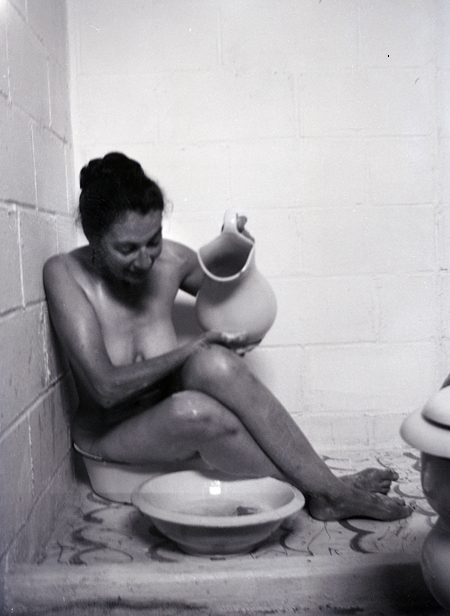
If Byrne Miller played Julia Roberts’ role, the movie would be called “Eat, Dance and Love Duncan.” Not that I could have convinced her to see the movie after reviews summing up the plot as “me, me, me and more me.” Byrne’s entire being was a partnership with the one man she loved so much she married twice. She was always part of “us” and “we,” never apart until her beloved Duncan died. He’s the one who took this photograph of her bathing, when they lived on a mountainside in Connecticut without electricity or running water.
Not that Byrne took any issue with self-indulgence, whenever possible. She once told me that the Byrne Miller Dance Theatre was just an excuse for her to get to see the best modern dancers in the world. She happened to live in a small town in the Deep South, but that was no reason not to expect the world to come to her. And come they did. Beaufort, South Carolina was the smallest venue on the First Freedom Tour of the International Glasnost Ballet – not to mention modern greats from Mummenshanz to Martha Graham and Paul Taylor.
“I’m selfish,” she bragged, “And I have a whim of iron.”
Her kind of selfishness, though, benefitted everyone who crossed her path. She, like the Julia Roberts character, knew romantic heartbreak. Duncan was not the first man who wanted to marry her, nor was he the last. When their oldest daughter spiraled into schizophrenia, they distracted themselves with other lovers to keep the stress from overwhelming their love. I’ve blogged about how she had to use reverse psychology to keep beautiful models away from Duncan when he was at the center of Advertising’s Mad Men days. She comforted dozens of adopted “daughters” dissolving in the drama of marriages gone bad. She understood and cheered for all of us, even encouraged us to have affairs to build back our confidence.
Byrne and Duncan traveled the world together, living everywhere from Manhattan to Santa Fe to St. Thomas. She danced in Ireland and Mexico, from Vaudeville burlesque troops to the very first companies of modern dance. She didn’t spend her life trying to be someone more worldly, centered or spiritual – she trusted that she was all that already or Duncan would never have fallen in love with her.
“You can never be everything to a man,” she always told me, “Nurse, lover, cheerleader, confidant, mother, conspirator, mentor – there are a thousand roles you can kill yourself trying to fill.” Somewhere there will always be a woman more beautiful, or more intelligent, perhaps more poised or even more independant than you feel you are. Her solution was something she shared with all her adopted daughters. Don’t try to compete. Don’t bother with jealousy. “Trust that you are the unique combination that the man you love cannot live without.”
I’m sure she would cheer the movie’s permission for spiritual growth, or how it encourages women to find themselves. But she would take it one step further. Share what you learn and what you love. She did in a thousand ways. When she arrived in 1960s South Carolina, she found public schools where children were classified as “handicapped” and incapable of dance. By the 1980s, she was teaching 700 of them a week – in their wheelchairs, with their hearing aids, from their dancing souls. She taught dance to military wives at Parris Island, Gullah-speakers at Penn Center and nurses at Beaufort Memorial Hospital. Every woman can move. Every woman can feel beauty.
Long before I even met her, she gave an interview to a Savannah newspaper. “Let’s face it, I’m a very ancient biddy. I never expected to live to 86, and here I am working until one o’clock night after night. No one told me you weren’t supposed to work that hard when you got that old! But you know, when it’s your own thing, you do it because it needs to be done.”
Eat, Dance, Love – not necessarily in that order.
The Re-parenting Dance
Summer is when I miss Byrne Miller the most. Maybe it’s the flowing clothes that catch the breeze, or the near nakedness of swimming in the creek outside her house. It’s the season for abandoning pretensions and inhibitions and the heavy, sticky heat of it reminds me of the woman who freed me. Until I met her, I was a little ball of guilt, trying to fix or placate my far-from-perfect parents. She was already in her 80s and had given up on that foolishness since before I was born.
“Blood relatives are simply people you were born with,” she always said. “Not necessarily people you should stick with. If they can’t make you happy, or vice versa, then I say choose your own family. It works for me.”
I was one of the daughters she chose. She showed me I didn’t have to grow into my genes, that I could pick and chose the traits I would preserve. There’s a bit of armchair psychology in all of this, I realize in looking back. “When the student is ready the teacher shall come” is only a cliché because it is so easy to confirm. My parents are grown-up runaways, suspicious of anything resembling roots or connections. There is nothing I crave more. I plant myself wherever I am and let rhizomes slither out, unseen, below my feet. In the sandy soil of Beaufort, South Carolina they touched something solid and I grafted onto it. Byrne taught me in ways my mother never could – without any genetic responsibility to steer me away from harm. I wasn’t so much a blank slate as photosensitive film. Just by exposing me to other worlds — her worlds of modern dance, writing, radical pacifism — she transformed me.
Children are instinctively aware of the nuances of family biology, how traps are set and reactions triggered. Expectations between parent and child are muscle memories, best unquestioned. Not so with parents we hand select. They have the capacity to catalyze thoughts, challenge assumptions. It can be uncomfortable, this process of discovery. And so writers, who like to pick at scabs, write about it. It doesn’t have to bleed through in memoir form, like it does in my Byrne Miller story. Novelists work it into the characters they imagine.
I have long suspected that writers re-parent themselves, that perhaps even the act of writing is part of the process. I don’t mean the old-school, Transactional Analysis spin on re-parenting. I have no desire to imagine my favorite writers sitting on the knees of their psychoanalysts, calling them daddy. Nor do I mean the Self-Help version of re-parenting: the mantra that we had no control over the stability of our parents but we can give our inner child the love they never gave us. I don’t know if it’s positive, regressive, dissociative or pathological. I have simply observed that writers latch on to people who are the polar opposites of their actual parents and never let them go.
Pat Conroy, the writer who adopted Beaufort as his home town when he arrived here as a military brat, finds delightful coincidence in the way my re-parenting began – with Byrne Miller. The story of his abusive childhood is known to every fan of The Great Santini and The Prince of Tides. What isn’t as well-known is how he survived it: by finding gentle men and women to replace those who were brutal and broken. One of the earliest women he unconsciously selected belonged to another teenager on the Beaufort High School baseball team. That boy dropped dead on the pitcher’s mound, and Pat met Julia Randel at her son’s funeral. He started checking in on her, and gradually she became the mother he wished Peg Conroy could have been. I asked him about it over lunch not long ago, as part of an interview about re-parenting for an essay I’m working on. He told me he doesn’t believe his picking Julia Randel hurt his mother’s feelings one bit; she had six other children to manage.
“Having Mrs. Randel treat me as one of her own allowed me to preserve my mother’s image. I needed her to be perfect. If I had to accept that my mother was as much of a jerk as my father was, I’d have killed myself. It’d have been too much.”
Pat’s upbringing, if you can call it that, is a horror I recognize only in the way he coped. He navigated by the radar of need, pulsing out invisible signals to almost every sane adult who crossed his path and listening for the echo. His clinging to all these surrogate parents is how I know the truth in what he writes, even though I’ve never been beaten, berated or otherwise brutalized. Re-parenting is the echo-location of acceptance, the chance to reinvent your personal narrative. Surrogate mothers and fathers don’t trade in the currencies of your failures, counting the ways you don’t measure up to genetic code. In your admiration of them they see promise more often than problems.
To find these parental replacements it helps to be socially awkward, more comfortable with elders than peers. Being a loner is a plus since revisionist history is a singular endeavor. Developing a sixth sense for loneliness will get you through doors closed to the over-confident or prematurely successful. Writers tend to notice tender interpersonal details like genuine interest or curiosity without judgment. Re-parenting yourself is surprisingly non-exclusive. You could be the child of wanderers, over-procreators, under-nurturers or simply selfish breeders. Re-parenting is not restricted to children of awful parents. It is a dance anyone can learn. Julia Randel taught the steps to Pat Conroy just as gracefully as Byrne Miller showed them to me.
The Scandalous Silver Slipper
If it’s too hot to do anything else, dance. You’re sweating anyway, right? Byrne Miller always said sweating is the sign of doing it right, whether “it” was dance or sex. It’s your body’s testimony to the effort, the consciousness of movement. She was always conscious of how she moved, and how dance is the most sensual of acts possible to perform alone.
I became conscious of the latter when she invited me to take a master class from Martha Graham dancers. They were in Beaufort, South Carolina for a week-long residency in the local schools. This was in the early 90s, when Beaufortonians were more likely to follow the Kentucky Derby than modern dance. But she lured them in anyway and created an audience for the brilliant dancers she brought here to perform for the Byrne Miller Dance Theatre.
The Martha Graham master class was the last obligation of the dancers before their performance, and Byrne selected the perfect location. About a dozen students waited for class to begin inside a wooden building that was once a dance hall in the black part of town, the Silver Slipper Club.
From the street, it looked more like a church or a one-room school house, polite in its pretty pinkness. But inside, the floor sagged in spots worn smooth from jiving soles and jitterbug heels. The uninsulated walls let secrets to slip out into the night, like notes from a long-ago blues singer. Fans of Jonathan Green might recognize the building from his painting of a red-headed white woman dancing in the arms of a blue-black partner. Restraint was cast away in the Silver Slipper, like shrimp nets into murky Beaufort waters. Of course Byrne would ask her followers to dance here.
There is no instant gratification or quick release from the monotony of ordinary movement. Dance is a learned pleasure, one that requires practice and sacrifice, years of it. When you can finally make your body obey your will, when every muscle in your arm becomes part of your reach, it is exquisitely satisfying. When your legs can lift as well as thrust, absorb momentum and create it – that is power. When your center can spin around itself, eyes focused on a spot in front of you turn after turn – that is seeing.
In a Martha Graham master class there are no classical poses, balances or fluttering across the floor on tip toes. Hers is a vocabulary at home in the Silver Slipper: violent spasms, trembling and falls to the floor. Graham called her signature contractions the physical manifestation of grief, but to me, pressed against the floorboards of a Gullah dance hall, they were birthing pains of belonging. Beaufort was the place I would later write about, in “Transfer of Grace.” Byrne was the woman who made me fall in love with it.
The class, billed as 90 minutes, swelled into two hours then two-and-a-half before, finally, Byrne moved out into the center of the Silver Slipper and began the chorus of applause. For the dancers, she clapped, for the students, for the spirit in the room and the sultry air that bound us all together one night in a Gullah dance hall.

When the economy tanks, give them bosoms!
It’s easy to think this recession is unique. We may indeed be the first generation to lose our houses to banks bailed out by our own pre-layoff tax dollars. But of course economic misery isn’t new, and every time I’m tempted to think it is I am reminded of Byrne Miller.
She came of age in the Great Depression and had to marry her husband twice because of it. The first time in secret, because leaving her father’s household to start her own would mean the family would lose the meager income she contributed. The second wedding was a few years later, when her father found work again. Only then could she declare her love for Duncan Miller in public, at the Manhattan City Hall. Still, money was tight. So she answered an ad in the paper for dancing girls and a career of fifty years began.
“I wasn’t one of the great ones,” Byrne once told me. I had thought her modest, knowing that she had danced in New York, St. Thomas, Santa Fe, Mexico and Ireland before she landed in Beaufort, South Carolina in the late 1960s. It turned out she was anything but modest.
“No darling,” she said. “It was these bosoms that got me noticed. That and legs that wouldn’t quit. It was the Great Depression, remember, men needed a lift.” The troupe, she later told reporters, was called the Sara Mildred Strauss Company. Eighteen or nineteen scantily clad women, many of whom had been prostitutes, made up the ranks. Her job was to stand on a pedestal, wearing two inches of cloth, and waggle her hips.
“Let’s face it,” she told me. “The legs have to be worth the ticket price.” As thousands of Byrne Miller Dance Theatre audience members over the years can attest, those she brought to Beaufort always were.
- ← Previous
- 1
- 2
- 3
- Next →
 "TeresaBruceBooks"