travel
Time Travel with Beaufort Rotarians and Byrne Miller
Aside Posted on
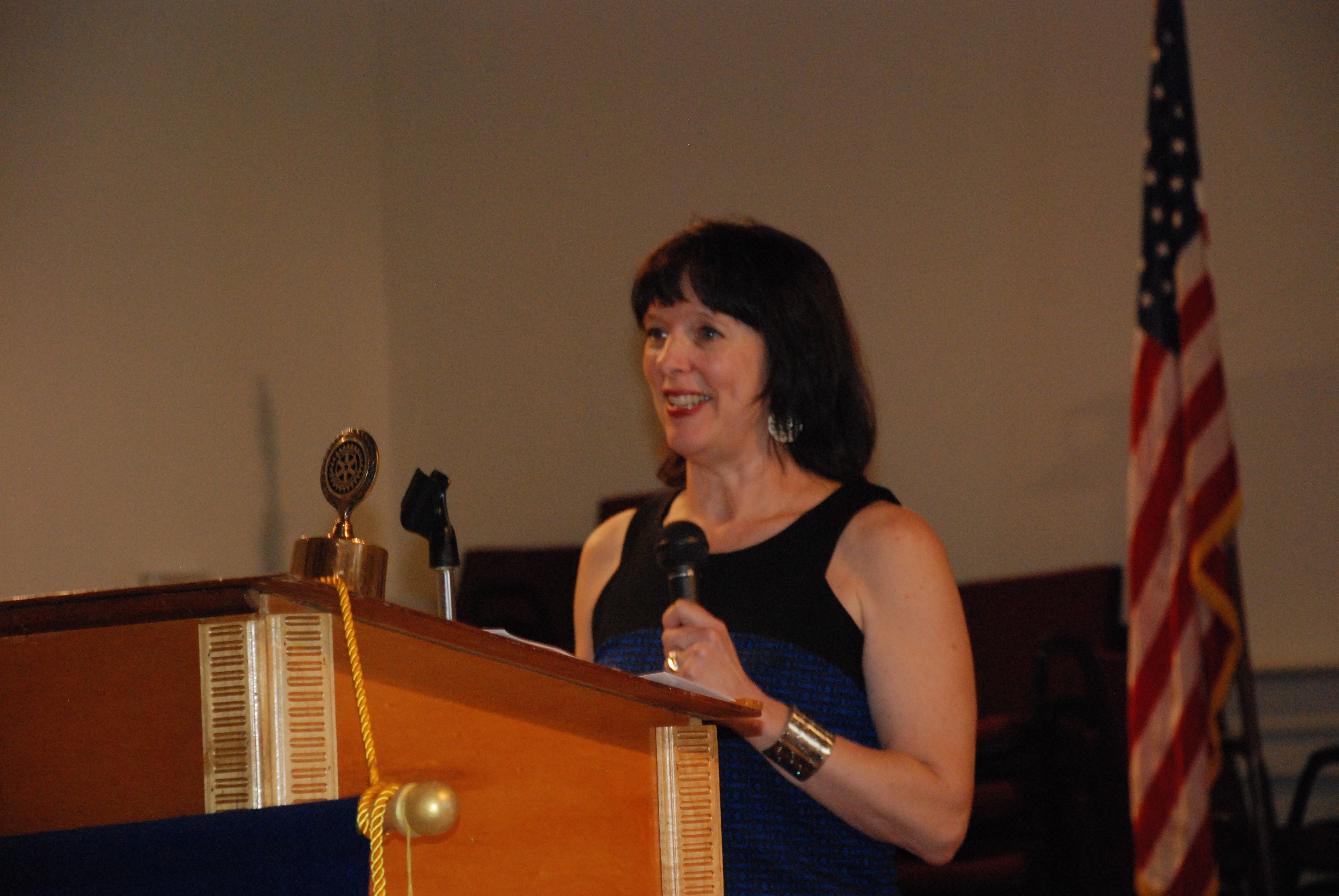
I just had the privilege of speaking about my new memoir to the oldest group of Rotarians in Beaufort SC. I say oldest not because of the age of its members, but because it was chartered in 1934. And some things really do get better with age.
I used to love covering the Beaufort Rotary Club luncheons when I was a young reporter at WJWJ-TV. The ‘90s were the beginning of a pesky objectivity phase in journalism when it became unprofessional to accept donations of any kind from an organization you were filming. But I made all of $16,000 a year back then and the Rotarians always insisted on feeding me lunch before I set up my Beta camera.
We reporters actually argued over who would get to cover luncheon addresses whenever the speakers were remotely newsworthy. If the Sheriff was speaking, we could always corner him afterword and get a soundbite about some ongoing investigation. If it was a county councilman at the podium, there was always some legislation he was pushing that became a news story that day.

The problem was the visual. Back when I was covering the Beaufort Rotary Club, it met in a hotel banquet room that would have taken more lights than WJWJ owned to not look as though I was shooting in a cave. So I’d grab my muddy-looking interviews and hope that back at the station I could find some file footage to cover up the voice-over. The infamous WJWJ archives even made their way into my book “The Other Mother: a rememoir.”
Recycled, three-quarter inch tapes lined the entire back wall of the WJWJ newsroom in a floor-to-ceiling shelving system that housed the television station’s file footage. It fell to an assortment of unpaid, questionably motivated interns each year to alphabetize the index card database. Even after six years of working at the station I couldn’t intuit the way the mind of a Beaufort High School senior worked. Footage of accidents might be listed under “Ax” instead of “Acc.” Coverage of airshows for the Beaufort Marine Corps Airstation could be filed under “P” for planes, “F” for fightertown or “J” for jarheads. — from “The Other Mother: a rememoir” Joggling Board Press 2013
Fast forward twenty years and I was the one behind the microphone, speaking to the Beaufort Rotary Club, and no reporter was in sight. Like the Byrne Miller Dance Theatre, the local media in Beaufort has all but disappeared. But what hasn’t changed is the small-town spirit of Beaufort, South Carolina and the Rotary Club is one of those foundations of community.

Ever since 1934, members have met for lunch each Wednesday. The only thing that’s changed is the venue. The Golden Eagle Tavern on the Beaufort River was torn down in 1971 and the club has outgrown the dingy hotel banquet room that made for such dark and grainy television footage in the ‘90s. Now the oldest group of Rotarians in Beaufort pledge allegiance and sing “God Bless America” in an enormous hall at the Catholic church on Lady’s Island.
Members have to put a dollar in a plastic bucket to earn the right to brag on another member or plug a personal cause. A financial officer dutifully reports the total expenses for the group last year: a $50 filing fee with the Secretary of State’s office. Each year they hold crab races to raise money for causes like swimming lessons at the Y and scholarships to the Technical College. The club’s biggest fundraiser requires every last member to sell 100 pounds of Vidalia onions each year. It’s small-town America at its finest – hip enough to have a female president named Harriet Hilton and retro enough to sport members with names like Fly Flanagan and Guy McSweeney.
I don’t know if Byrne Miller was ever invited to speak at a Rotary Club luncheon but several of her collected children were in the audience for my talk. Many of them graduated from the old Beaufort Elementary, where Byrne first demanded to teach movement therapy in the 1970s.
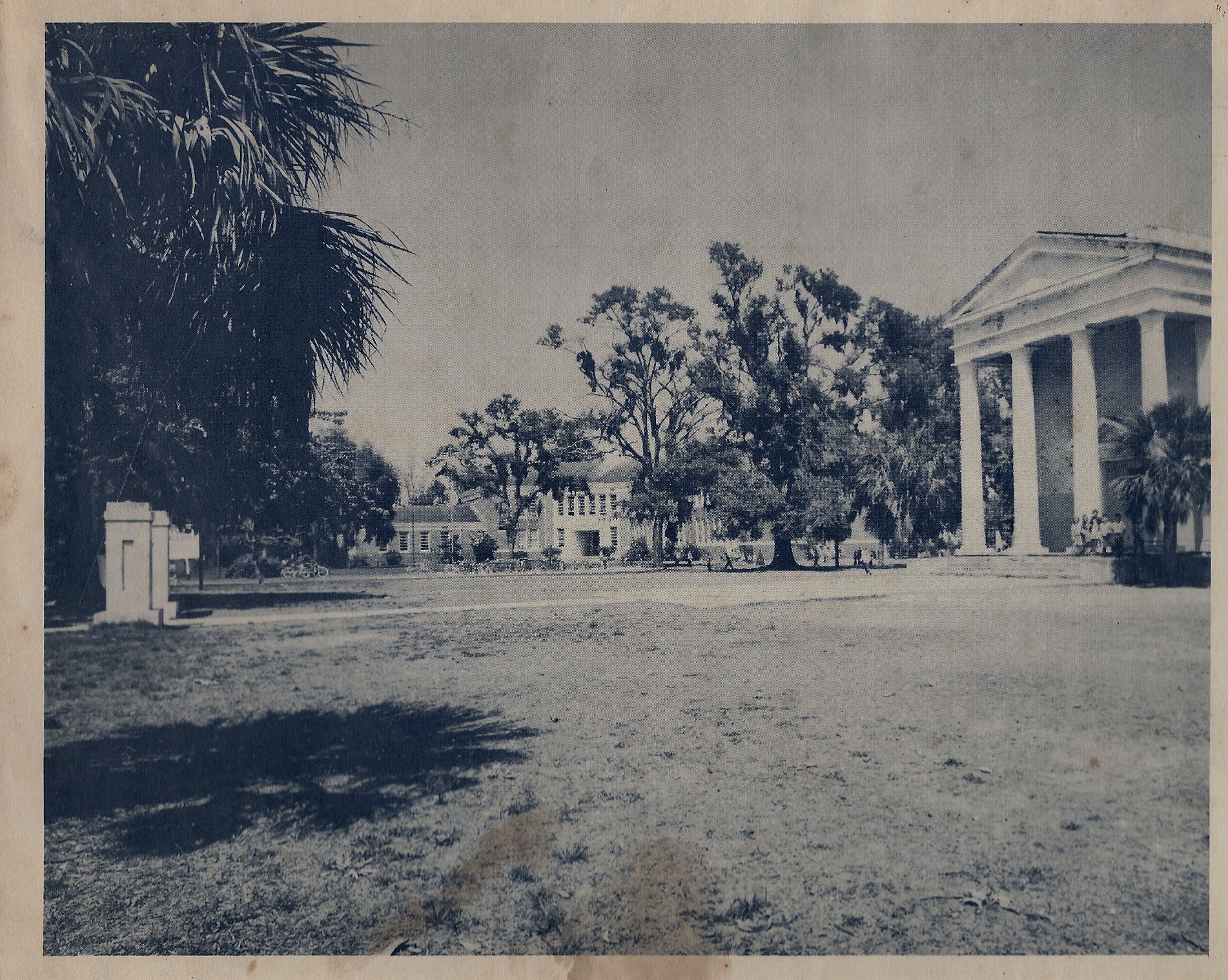
You’d think after spending five years writing a book about Byrne and Duncan Miller I’d have heard all the stories. But after my presentation, a physician in the audience elaborated on Byrne’s incredible toughness (she survived five spinal surgeries and still taught modern dance into her eighties). “We’ve done medical studies on dancers,” he said. “And it turns out they can take three times as much physical pain than ordinary people.”
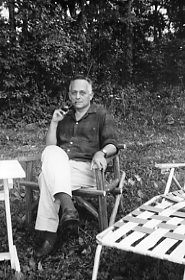
 A former neighbor of Byrne’s told a story of how Duncan used to complain about a barking dog who lived two doors down. I knew only the utterly romantic and melancholy Duncan – a writer who adored his charismatic, modern dancer wife. But it turns out before he lost his speech and memory to Alzheimer’s, Byrne’s muse could also be that quintessential cranky old man yelling “get off my lawn.”
It’s a good thing he was married to a woman with a self-described “whim of iron.” Rotarians who were members of Byrne’s board of directors remembered how prickly Byrne got too — when anyone suggested she book more classical, ballet companies for the Byrne Miller Dance Theatre.
“Ballet they can see anywhere,” Byrne would say of her audience. “I will make them the elite; connoisseurs of modern dance in the Deep South.”
I had to chuckle. The genteel, very Southern members of the Rotary Club of Beaufort ended their meeting by reciting what they call the Four Way Test: questions all Rotarians are supposed to ask themselves before they speak or act.
1. Is it the TRUTH?
2. Is it FAIR to all concerned?
3. Will it build GOODWILL and BETTER FRIENDSHIPS?
4. Will it be BENEFICIAL to all concerned?
So would Byrne have made a good Rotarian? She always spoke the truth, even when it wasn’t fair to all concerned. She was more concerned with building sophisticated audiences than goodwill, but would do anything for a friend. And I can’t speak for all concerned, but having Byrne Miller as an other mother was certainly beneficial for me.

That scandalous TED(x)
I’ve just been asked to emcee the 2014 TEDx Charleston – I’m allowed to go public with the news today because the women who run it have just released the names of this year’s speakers. Up until today only the theme was public information: Ripple Effect.
If it all sounds rather clandestine, it’s because it is. Being involved with TEDx is a little like an affair. Press embargoes, trips to the most romantic city on earth: Charleston, late nights meetings about with a mysterious “TED.”
Somewhere Byrne Miller is winking with approval. It was at the inaugural TEDx Charleston in 2013 that I had the chance to introduce her, in spirit, to a world of You-Tube viewers. My talk was called “The Wisdom of Quitting: Lessons from my Other Mother.” Back then I agonized over whether the sophisticated, well-mannered Charleston audience would be shocked by Byrne’s most outrageous womenism.

I needn’t have worried. The audience saw past Byrne’s cheek to her wisdom and have become enthusiastic supporters of “The Other Mother: a rememoir.” But the organizers of TEDx Charleston all looked at each other with knowing smiles. This team of dedicated and well-connected women, led by the indomitable Edith Howle, run an entirely independent event. There is no TED headquarters handling all the logistics. These women have to plan everything from speaker selection to ticket sales, catering, media coverage and after-party venues.
So why the smiles at Byrne’s affair advice? It turns out all of them joke that “TED” is their shared, demanding, artistic, maddening lover.
A picture is worth a thousand words. Unless you can’t write.
Parents often ask me if it’s “worth” sending their kids to art school. I cleverly read between the lines and realize they’re actually wondering if their child — and his/her paint brushes, pottery wheels, tripods and assortment of laptops — will ever move out of the house and be able to make a living as an artist.
The answer is yes, IF. And this particular IF is non-negotiable. But before I explain, I should give my tepid qualifications to respond in the first place.
I assume these parents consider writing an art or they’d never ask me in the first place. And while I’m not likely to get rich off my first book, my writing skills are valuable far beyond the tiny bubble of memoir. Every job I’ve had – from newspapers to broadcast, public relations and freelance video – I got because I can write.
I moved up the management ranks at Ogilvy PR Worldwide because I can write. And in that capacity, I hired art-school grads. So I know they can be employable.
So the question isn’t really where an artist gets his/her degree, it’s IF that program also emphasizes writing. Check SCAD’s course descriptions. Beyond the actual degrees they offer in writing, SCAD students can choose from almost 100 courses with the words writing in the title.
SCAD administrators don’t offer all those classes out of some sense of liberal arts legacy. They do it because most artists also work in other fields. In the waking hours when artists are not creating art they teach, they promote, they design, they code, they raise money, they publicize, they report, they research. That part isn’t new.
What has changed is that all artists today have to be entrepreneurs, even those in the purest, classic art forms. You want to paint landscapes for a living? You’re going to have to describe that work in order to sell it. Want to teach studio arts? You’re going to have to write a fabulous application essay for grad school. Want to exhibit your work? Try getting a grant without solid writing skills. Want to open your own photography studio? Someone’s got to post blogs and write press releases to submit to local media. Fancy yourself a gallery owner one day? You’ll be writing everything from content for your website to articles about openings. Want crowd source funding for your aboriginal sculpture research? Those clever You-Tube documentaries have scripts. With words that somebody wrote. Want to collaborate with other artists on a big project? You’ll have to write a creative brief and project summaries.
No one will know your work better than you. No one will be able to convey your passion more articulately than you. No one is going to do your marketing and messaging for you (at least not for free). The key is realizing that all working artists are their own brands. And you can’t build a brand if you can’t write.
So my advice to parents (and students) considering a degree in the arts is yes, IF. Do take the plunge IF the program also teaches you practical writing. As an artist, writing skills will give you the self-sufficiency to build an audience, reach investors and communicate your vision. And even if you end up choosing not to make a living as an artist, you’ll have a skill set that transfers to almost every field connected to the arts.
Book Club in a Yurt
As a brand new published author, I still pinch myself when I’m invited to book club meetings where the members are discussing the book I wrote. Each time it’s a thrill but the setting for such rewarding encounters will never be more exotic than this yurt.

That’s right: a yurt. As in, wall-to-wall luxurious Persian rugs and velvety soft pillows. My camera lens wasn’t wide enough to capture all the women who fit inside but they included the leaders of practically every important committee, museum and social organization in Beaufort, South Carolina. This particular yurt is hidden inside the home of a member of the Peggy Verity book club. If I had to invent a backdrop where the spirit of Byrne Miller would infuse a discussion about her storied life, this would be it. Just stepping inside the yurt reminded me of the night when Byrne taught belly dancing at a bridal shower for one of her collected daughters.
So it wasn’t surprising that, sheltered in such dramatic romance, a dozen denizens of Beaufort society freely discussed everything from open marriages to what, officially, counts as crazy. Some of these worldly women studied modern dance in college, back in the 60s, and nothing about Byrne was as shocking to them as their distinguished public personas might lead you to presume.
I was brought to the yurt by a woman I’d only recently met at an Other Mother Soiree. But when it was Katherine Lang’s turn to pick a book for her regular monthly book club she chose the story of how a complete stranger showed me the person I was supposed to be. The book club in a yurt brought it full circle: me sharing a deeply personal, even intimate story with a group of women who until that moment had been strangers. Many of them had known of the fierce, strong-willed woman who planted the seed of modern dance in the Deep South through the Byrne Miller Dance Theatre. But even those who had been season-ticket holders hadn’t known the full story of the woman behind the brave front: the Byrne Miller who did it all while caring for two family members battling schizophrenia.
I think that’s why the book speaks to so many different types of readers. We all fight internal battles invisible to the outside world and it’s a tightrope act to know when to inquire or intervene. Even though I’ve now made my story public, it was still easier for the women in the yurt to ask me about Byrne’s secret battles than my own.

An equal and opposite experience came four days later when my own book club – The Mockingbirds – devoted its monthly meeting to “The Other Mother.” We are a much smaller harem, only a half-dozen women, and I’ve known some of them for ages. The scholarly reader perched above my right shoulder, Lolita Huckabee, even appeared in an earlier draft of the book. (The story didn’t make it through the final revisions, but Lolita and I, long before we met the men we love today, started a man-hater’s club in Beaufort. Judge Ned Tupper was an honorary member.)
So it came as a surprise that Lolita was worried, when the book first came out, that I had shared so much of my personal history with domestic abuse. She’s a book guru and knows that the criteria for publishable memoir is go deep or go home. But Lolita is an other mother to every reporter who has ever passed through Beaufort and feels particularly protective of me – the reporter who came back to make this place home. That friends like Lolita care so much is one reason I did.
Most of the Mockingbirds arrived in Beaufort after Byrne’s time, so they were more interested in my story than hers. Their questions were clearly attempts to reconcile the friend they know in real life and the young woman who narrates the book. I’ve tried to prepare friends for reading “The Other Mother.” I’m not a particularly private person and I like to think I’m a good listener. But even if they’ve heard some of the same stories over glasses of wine on my back porch, it’s startling and disconcerting to read them on the printed page. I tell them to pretend it’s not me, that it’s a story about some other woman who just happens to have the same name.

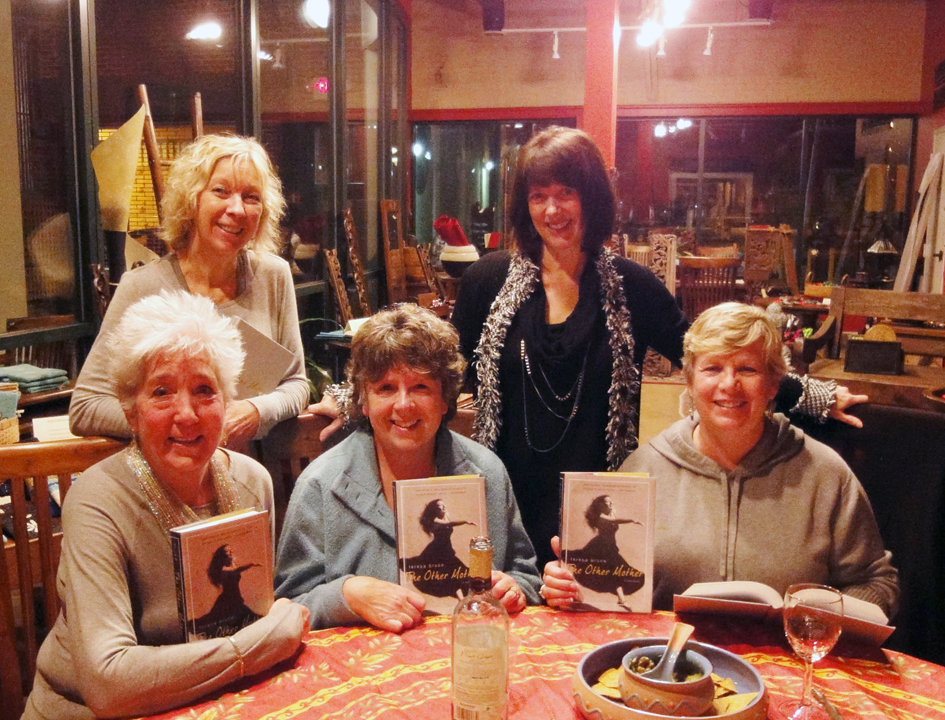
The beautiful thing is that they can. Not because my hair was dyed blonde back then but because the TV reporter in the story is both me and not me. Identity never stands still, and women are necessary experts in reinvention. If we weren’t, we’d never be wives, or mothers or other mothers. The toughest part of my story is communal and shared, known in the way women have always known the truth. I can’t keep count of the number of women who linger at book signings, a little squeeze of the hand telling me that they too, have been there.
If I could reinvent myself one more time, my new career would be human cheat sheet. I would gladly travel to any yurt in the world to meet with book clubs reading “The Other Mother.” I may have written the discussion guide questions but I’m still discovering the answers.
Rants and realizations
It took some newly discovered other mothers to get me past the apoplexy of a news story while I still should have been basking in the glow of the holidays. The journal Science published a Harvard study about the effect of expanded Medicaid benefits on the frequency of emergency room visits among a select group of Portlandians.
My ears perked up at the mention of Portland – we’d just visited for my grandmother’s 90th birthday. But quickly those ears began to burn. The report was sloppily characterized to condemn “Obamacare” as a failure because the study subjects visited emergency rooms more frequently once they had access to Medicaid coverage than before they did. The tone of the story was one of condemnation and “we told you so” – as though these lower-income people were at once greedy, ignorant and hypocritical.
I say my ears burned, because those of you who’ve read “The Other Mother: a rememoir” now know, I was raised in trailer-park economic conditions in the backwoods of Oregon. My parents were “guilty” of relying on emergency rooms whenever my sister and I got hurt or sick and for their own, irregular health care. I never had a family doctor or preventative anything, and it wasn’t because my parents were lazy or on welfare. They both worked outside the home – my father left the house at 4am and didn’t return until after dark from his low-paying, unregulated, unsafe job as a truck driver.
Which is why my parents relied on emergency rooms. Ear infections, epileptic seizures, heart murmurs, strep throat, dislocated thumbs… off we went to the nearest hospital. There were no doctor’s offices open when my parents could take us – even had my father been able to afford insurance. Neither of my parents’ jobs offered paid sick leave so if they had to stay home because of an illness we were short that month on rent or groceries.
So to hear the Harvard researchers blithely attribute the results of the Portland study to “limited education” about what constitutes emergencies made me dash off an emotional post on Facebook. It wasn’t fair to knock Medicaid and give lousy employers a pass. I know of no poor person who wouldn’t rather sit in a nice comfortable doctor’s office watching cable cooking shows and thumbing through Oprah magazine than wait, sometimes for hours, in an understaffed ER.
Here’s where my newly discovered Other Mothers came in. It turns out Byrne Miller isn’t the only woman with patience, understanding and a different world view to share. Even though they (mostly) agreed with me, these women (and a few men) gently prodded me to dig deeper into all sides of this issue that had become so emotional.
One book-loving Other Mother is an artist who holds out hope that as Obamacare rolls out, other health care providers will figure out how to make non-critical care more accessible.
“The future holds opportunities for a new type of healthcare industry utilizing technology, and career opportunities for yet to be named professions. There will be those smart enough to capitalize on this, routine tests, immunizations, and treatment for simple accidents etc., will be done in shopping malls, convenience centers etc.”
But another Other Mother is a nurse, and she warned of an impending shortage of well-trained health care providers.
“Healthcare insurance availability is but one aspect of “the system,” and increasing those able to afford/obtain insurance is a plus. However, issues of “enough” medical personnel and systems designed to be truly “patient-centered,” are huge. … MD’s, Nurse Practitioners, Pharm.D, are, and will remain, “critical” to providing comprehensive care as they are prepared to assess the “big picture,” rather than just ” give the shot.”
I realized that my initial reaction was mightily influenced by my own life experiences. Valuable as those are, I needed a reminder of how important the insights of Other Mothers are – we are never too old to see a different point of view, especially when its shared by someone who really “gets” us. And we are never too young to pay it forward and become the other mother someone else will need and cherish.
Dear 2014: I resolve to be a little more like my 90-year-old granny
I am usually thrown into a consumerism coma the minute I enter a Costco or Sam’s Club. The clatter of jumbo shopping cart wheels and vendor calls proffering some miraculous new processed food makes me claustrophobic. But it’s the fluorescent lighting that throws my internal clock off balance – I feel like I’ve missed a flight, slept through several time zones and woken in an underground world where the sun has been distilled into the chemical components of illumination. I make no good decisions under these conditions, so I usually tune out, nod and agree with whatever fabulous bargain my shopping partner discovers. I let others do all the mental math of dividing super-sized deals into comparisons with normal grocery quantities. But I couldn’t zone out this time. I was the reason my aunt brought me to Costco in Aloha, Oregon in mid-December – I had decided that we needed to throw my grandmother a 90th birthday party. Since she lives in a senior community, catering the party ourselves was out of the question. Auntie R’s Costco membership card to the rescue.


I think my aunt was stunned when I piped up with an idea for the decorative lettering on the massive sheet cake we were ordering. Without hesitation, I filled out the line on the form for the “personal message.” A day later we picked up a flowered, frosted, manhole-cover sized cake that read: “Nellie at 90. Still giving ‘em hell.”
There’s a madness to my method. In her day, Nellie Fox Edward was hell on heels – the only woman in the world of Oregon labor unions and almost the only woman lobbying in the state capital in Salem. She ran for state Labor Commissioner once. Apparently my 12-year-old self, wearing a sandwich-board sign reading “vote for my Granny,” wasn’t cute enough to sway the outcome. But granny took the defeat in stride, put in a few more years of two-martini lunches with union organizers, and almost got herself nominated for Secretary of Labor under Jimmy Carter. He even flew her out to DC for the interviews. There is not a woman alive who hates Ronald Reagan more than Nellie Fox Edwards. Death did not excuse him from robbing Carter of a second term.
 Still, my aunt wondered if the cake’s lettering would resonate with a crowd of retirement home residents. Or even with granny – her cognition is struggling to keep up with her legacy, or as she puts it, “my forgetter works real good.” Truthfully, I wasn’t thinking of her retirement home neighbors; I was thinking of the invite list. Granny and I had been working on it for months and she insisted on sending invites to several governors and a handful of senators and representatives as well. Privately I thought she’d be disappointed – it had been decades since she left the capitol — but I sent them anyway and three days later the first RSVP arrived. Former Governor Ted Kulongoski wanted to know what he should bring. So did Congresswoman Suzanne Bonamici – planning to return to Oregon in time for the party as long as the House passed the budget agreement.
I called granny a week before the party to ask if she was getting excited. She sounded sad and I asked her why. “I just wish you were coming,” she told me. When I reminded her that I was the one organizing her party she brightened up and told me I made her day. There is an upside to a good forgetter – lots of nice surprises.
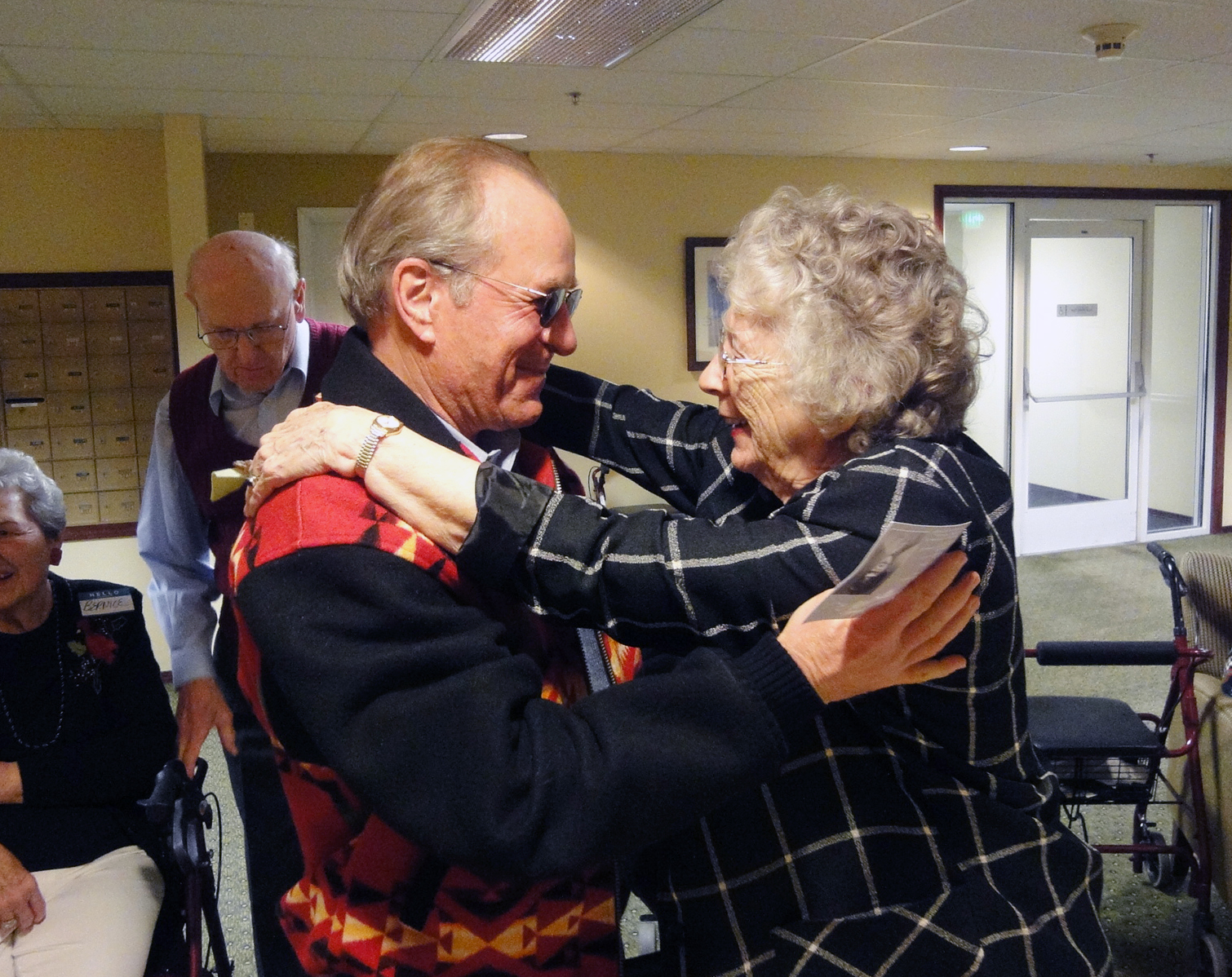
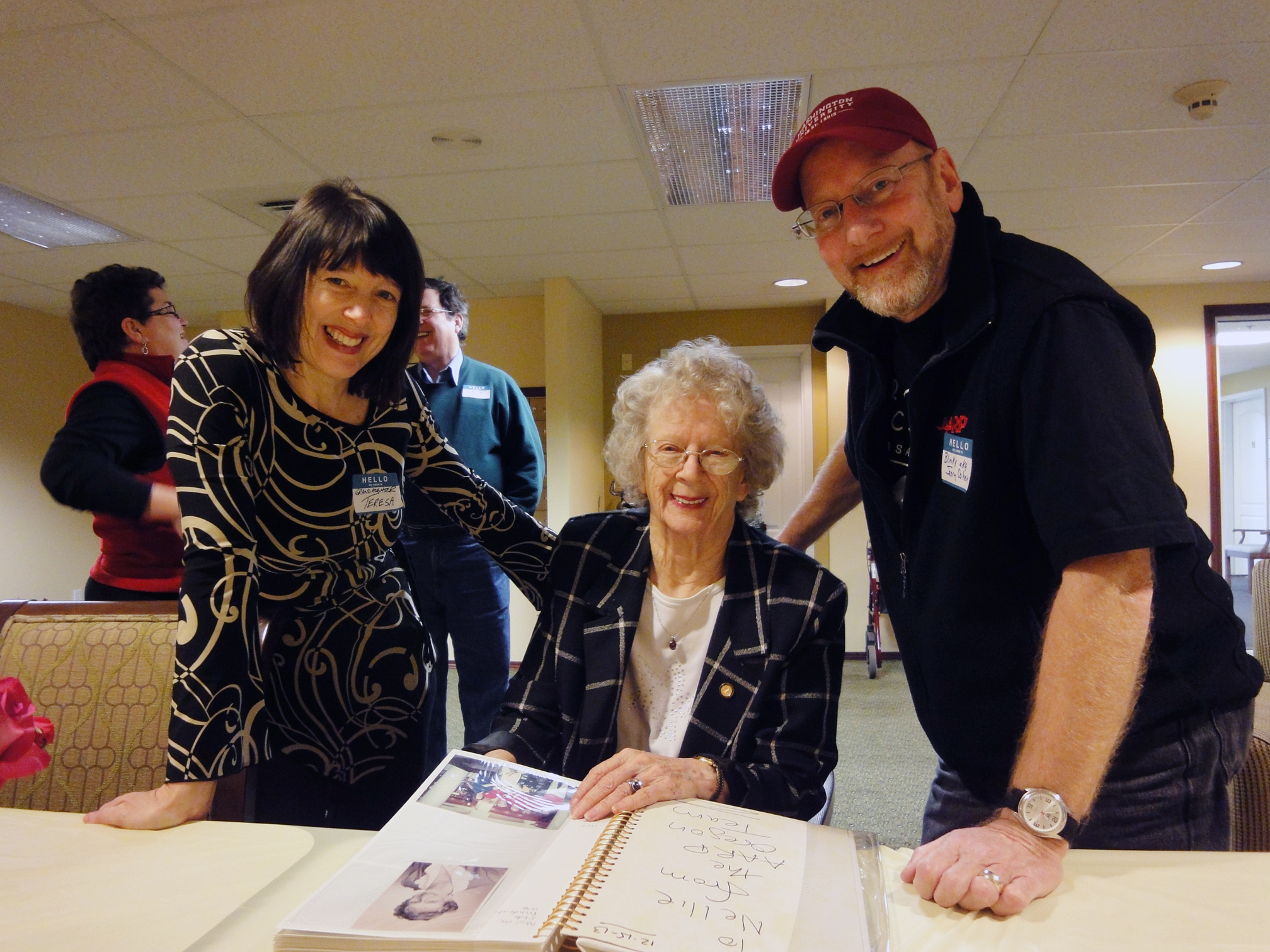

Party day arrived and granny pulled out all the memory stops. She remembered names and shared histories and got teary-eyed thumbing through a photo album an AARP colleague prepared in her honor. She ate two slices of cake and left bright red lipstick smears on the cheeks of Governor Kulongoski. She made sure Congresswoman Bonamici signed her guest book and leave her phone number. She snapped her fingers every time she wanted Gary to take another photo of her hugging someone. There were family members there who’d driven six hours to celebrate her birthday and she clucked over each of them too, though not quite as much as the celebrity politicians.
The next morning, I waited until 10am to give her a call. “I wanted to let you sleep in Granny,” I told her. “You must be exhausted after all that excitement.”
“Oh I was up at seven,” she replied, “writing a nasty letter to Governor Kitzhaber for not showing up.”
Apparently one governor wasn’t enough for the woman who demanded all politicians pay attention to organized labor, women’s rights and medical coverage for the mentally ill. It turns out her forgetter wasn’t working as well as we all thought it was. She fought hard her whole life and expects the people she supported, especially men, to give her the respect and attention due. As the sitting governor of Oregon was about to find out – the cake was spot on.
All I want for Christmas are Amazon and GoodReads reviews
Sorry diamonds, this girl has a new best friend: reader reviews on Amazon and Goodreads. Truth be told, diamonds and I never have been well acquainted – but all that could change if I can amass enough “The Other Mother: a Rememoir” reviews before Christmas.

It’s a happy accident, really, that the book is out in time for men to impress their wives by tucking it under the Christmas tree – or more likely for women to wrap up for their mothers and other mothers. But the only way Byrne’s story spreads beyond this rarefied world of people who actually knew her is if enough readers leave reviews on those two particular sites: Amazon and Good Reads. Crazy but true — rankings and algorithms too complicated for my feeble brain depend on it. The new reality is that other than loyal local publications like Lowcountry Weekly, Beaufort Gazette and the Charleston City Paper – not many national book reviewers have a platform anymore.
Writers have spilled enough doom-and-gloom about this to keep barkeeps in tips for the next ten years, so I’m choosing to look on the bright side. The internet is full of talented bloggers who fight the good fight to keep books top of mind. The fact that there are fewer gate-keepers means we can all crash the gates! Every reader’s opinion matters on Amazon.com and GoodReads. In many ways it’s a more egalitarian world without the literary elite controlling which books are anointed and which pilloried. My friend and mentor, Pat Conroy, always says “The New York Times giveth, and the New York Times taketh away.” He finds most conventional reviews capricious and mean-spirited and vowed long ago never to accept offers to snarkily critique the work of fellow writers in national publications.
That said, he still writes his books long-hand – so his fabulous blurb on the cover of my book is not likely to end up as a review on Amazon.com no matter how much he loves “The Other Mother” (and he says he’s giving it away as Christmas presents so I know he really does) But miracles do happen, especially at Christmas, so in the spirit of information sharing I’ve made a how-to list to help those less internet savvy join in this modern word of mouth. (Conroy – I’m talking to you.)
To leave “The Other Mother” a review on Amazon (and you don’t have to have finished the book – even your initial thoughts count) just click on this link to my Amazon review page. If you want inspiration, just scroll down and check out the insights others have already left. Then just hit the Leave a Review button and start typing.
Once you register with GoodReads their review system work almost the same way. You start by going to my book page and give the book a “rating” – in stars – first. Find the stars by looking under the thumbnail picture of the bookcover and the green “READ” button. Then click on the underlined title of the book itself and it’ll take you through to another page where you scroll down to “My Reviews” and type whatever you’d like in the blank field. Just hit save and you’re done.
See? Easier than dressing up in a red velvet suit and playing Santa. May mistletoe dangle wherever you innocently hover.

Why Blog Tours Rock
I’m on tour with “The Other Mother: a rememoir” – right now, from the comfort of 75-degree Beaufort, South Carolina, where I watched dolphins gliding through the creek this morning. Yes, tour – only this book tour isn’t the usual sit-near-the-bookstore-door-and-politely-tell-tourists-where-the-bathroom-is kind of tour. It’s a virtual tour, with each stop over a ten-day period “hosted” by a blogger I’ve come to know and admire. Or, in the case of a fellow writer Ann-Marie Adams – a Q&A everyday of the tour!

The beauty of blog tours is their flexibility – and not just because I can jump into online conversations in my slippers. What’s been so fun about this one is reaching out to a wide variety of bloggers to see if they’ll read the book and share their thoughts and questions with new audiences. Some are planning on posting reviews and others on challenging their readers to pose questions of their own. It is as creative as the bloggers themselves – and if this collection of writers is any indication – you might want to subscribe to their blogs now and follow them for years to come.
So here are the official blogs stops on “The Other Mother: a rememoir” tour:
 Beaufort and Philadelphia readers might already know Ann-Marie Adams. She’s a study in reinvention herself – which is why I knew she’d love Byrne’s “womenism” that “there is no contract on earth, especially between a man and a woman, that cannot be rewritten.” Like Byrne, she’s taken her gift with words and illustration and segued it into a career ranging from a lobbyist for Cornell University to the Hilton Head Island Hospitality Association. Her blog “SC Mornings” kicked off the tour and every day she’s pulling quotes from the book, turning them into a provocative question and blogging my answers as well as comments shared by her readers near and far.
The only other semi-local blog stops on the tour are two of my favorites – and they couldn’t be more different.
 Stephanie Hunt writes even more than I do – from Charleston Magazine (I’m still pinching myself over her November issue review) to SKIRT to her own, fascinating blog called Charleston Grit. We discovered we have a mutual friend through Byrne – one of Stephanie’s closest friends is a modern dancer who used to make the trek to Beaufort for Byrne Miller Dance Theatre master classes. The cool thing is, Stephanie’s blog tour stop will include the review she wrote for the magazine – available for the first time only on-line!
 Louise Hodges is a chameleon – a very sassy chameleon. She turned a small-business incubator grant into the way-environmentally-cool Green Bug All Natural line of pesticide free bug sprays, right here on Lady’s Island. In her business blog she writes about everything from how to get rid of bed bugs to why Monsanto is the scourge of the earth. The connection to Byrne might not be obvious, but Byrne Miller’s first professional writing gig was writing for a magazine in the 1930s called Nature’s Path. But Byrne would have loved her for another reason. She can sing and hustle a tambourine with the best of them – which is handy since her husband is in a band.
The point of a blog tour is reach – so I’m also excited that several far-from-Beaufort bloggers have agreed to host a stop. Not all of these will be posting between December 1 through 10 – but start following them now so you won’t miss it when they go live with “The Other Mother” tour.
 Dance fans will be twirling in their imaginary tutu’s because Heather DeSaulniers has signed on. She’s a former professional ballet dancer, now dance critic and host of her own dancer’s blog which got tapped as one of the top ten dance blogs in the country. I love her blog because, unlike dance critics in New York, she isn’t about impressing you with snarky reviews. While Byrne herself was a tough dance critic (she wrote for Jacob’s Pillow and reviewed Spoleto dance performances in The Beaufort Gazette) she would have seconded every Heather motion.
Then there’s possibly the coolest indie bookstore west of the Mississippi – Santa Fe’s Collected Works. Byrne Miller Dance Theatre began in Santa Fe, in her home studio on Canyon Road, and while I was out there doing research for the book I stumbled onto Collected Works. It’s the kind of bookstore that builds community, that author’s dream of reading at.
 Only it’s too far away for an actual tour stop so I was thrilled when reviewer Christopher Johnson said he’d read “The Other Mother” and ask questions via the official bookstore blog. I can’t wait to get his questions (no pressure Christopher, I know you’re swamped) because he never falls back on the usual, pat Q&A. Check out this question he posed of poet Shaun T. Griffin “What is the difference in your mindset when you are working on a poem or a translation or a book of scholarship? Do these works all come from the same place inside of you or are they separate places?” My writer friends — commence drooling.
 I knew I wanted Melanie Page to be on the tour when I read her “about” quote at Grab The Lapels. She went straight for Maya Angelou’s “I love to see a young girl go out and grab the world by the lapels. Life’s a bitch and you’ve got to go out and kick ass.” Any blogger who writes about women writers and books about women is kick ass. Plus that quote reminds me of one of my favorite Byrne “womenisms:” – “A whim of iron simply rejects rejection.”
The final two stops on the blog tour might not be what you’d expect. They’re in the category known as mommy-bloggers and why not? The title of the book is “The Other Mother” and I’m curious to know what these modern-day moms think of Byrne’s unconventional parenting techniques (her daughters lived in a treehouse, for a spell) and the concept of other-mothering.
 I’ve always believed that needing and cherishing the love of other mothers, as I did, in no way competes with biological parents. While it’s cliché now to say it takes a village – there’s a reason cultures over the world and through the ages have embraced the concept.
Now we’ll get a chance to see what hip young mom and pro-blogger Andrea thinks – I learned of her Northern Virginia Housewives blog through the friend who hosted my Other Mother Soiree last week in Washington DC. And no – she’s not in any way connected to the hot mess of the other “real housewives” of NOVA. She’s just getting the book now, so it’ll be a while before she can join in but I can’t wait.
 And last but not least is Motherhood and Miscellany. Amy had me at Oshkosh, Wisconsin – which is where she blogs from. Followers of my blog know that the family that “adopted” me when I married Gary is all from Wisconsin. So when Amy said yes, I poured a glass of Leinenkugel and sent a book off to the wilds of northern Wisconsin. I especially loved her “The Mother Comparison Game” post. It reminds me of why Othermothering can be so rewarding. I admire any woman who becomes a parent in this era of labeling – if you’re ambitious you’re a “Tiger Mom” and if you’re too involved you’re a “Helicopter Mom.” I’m hoping Amy’s blog will help “Byrne” the tables and encourage women to stop judging and start loving. Let the comments flow!
What not to ask a college student at Thanksgiving
Thanksgiving is a tricky trip home for college age family members. They’re getting free food and use of a washing machine and that’s welcomed. But the minute they lift a forkful of mashed potatoes to their lips some uncle or grandmother is going to ask what they’re going to do when they graduate. This blog posting is a plea to cut them some slack.
I was reminded of just how stressed out college students are when I talked to students at a leadership conference sponsored by the College of Charleston’s Higdon Student Leadership Center. There’s no way I would have said no when a student who watched my TEDx talk liked it so much she lobbied for me to be the keynote speaker. They even themed the conference after my talk: The Wisdom in Quitting. Still, I was nervous. I had an hour to fill and I wasn’t sure that College of Charleston and Citadel cadets would really “get” Byrne Miller’s words of wisdom.
It turned out they wanted mine. Not because they all want to be writers, or dancers. But because they could relate to the fear I had of disappointing my parents when I had to quit my Olympic quest. I make no secret of how much I hated competing — now. But I’d been raised never to quit and back then I felt like my parents, my coaches, my college – hell even my country was depending on me to represent the U.S. in the Olympics. It seems ridiculously pompous and self-absorbed but that’s how successful kids are raised – when you are the center of your parents’ universe you think their happiness depends on you.
I was terrified to quit anything… from a boring book to an abusive boyfriend… because being perfect was my entire identity. It took the wisdom of my Other Mother to choreograph the steps of my own life.
So back to the talk at the College of Charleston. I’m used to smaller audiences, where it’s easy to make eye contact and get a read on the room. The students were polite, but I couldn’t tell if I was getting through. I offered to take questions but the organizer interrupted and asked if I would meet with students one-on-one after the conference. As it turns out, he knew that the silence during the talk was actually the sound of brains churning. I ended up talking to Citadel and College of Charleston students for 45 minutes and it hurtled me back to my broken back and the days when I had no idea who I was supposed to be. They told me of being the only person in their family to go to college. How they were finding out that they didn’t want to be the doctors or lawyers their parents expected. One African American cadet in her impressive Citadel uniform asked me how to tell her proud family that she wants to walk into another room – and not into the military.
Suddenly Byrne’s sassy womenisms didn’t seem appropriate. I didn’t want these vulnerable students to think that there’s an easy answer for one of life’s most difficult transitions – the one from following our parents dreams to speaking up for our own. I told them that they were way ahead of where I was at their age – it took a broken back for me to even begin to think of quitting what wasn’t right for me. And I told them that change doesn’t have to be instant. Researching, exploring and planning alternatives before taking a major step isn’t the same thing as procrastination or indecision in the same way that quitting isn’t the same as failing.
We took some pictures, had some hugs and they were off – bravely plunging into the confusion and pressure of lives still on the threshold. And of course, I thought of the advice I should have given too late – on the long drive back to Beaufort. So this is for any of them reading this blog – or any 20-something at your Thanksgiving table. It’s one of Byrne’s wisest womenisms: “There is not a contract on earth that cannot be rewritten.”
I take great comfort in the truth of this — even now. It gives me the courage to trust my instincts instead of pre-judging every step I take. After all, identity is just a contract we make with ourselves.
Why Mothers Go Other
Do women assume their mothers are insecure and jealous? I am beginning to wonder, after the same question comes up at every reading or Other Mother book soiree. A hand goes up and someone will ask, almost apologetically, if my real mother was ever jealous of Byrne Miller – the other mother of my memoir’s title. I’ve stopped being surprised by the question, even though in truth it never occurred to me before I wrote the book. I loved both mothers without comparison and assumed the inverse was true. Because my mother was a coach and therefore an other mother to many gymnasts, I never even wondered if she’d mind about Byrne. I knew, with the lucky certainty of the truly loved, that she always wanted the best for me and never declared a monopoly on what the best was.

Last week dear friends in Charleston threw a soiree for the book and for the first time, the discussion quickly moved into deeper, fascinating territory. I was prepared for the jealousy question and I could see by the smiles in Andrea and John’s elegant sitting room that my “no, I think she was relieved” answer met with agreement, and approval. These were confident women, some of them mothers, some them daughters of other mothers. The questions quickly moved on to all the other juicy topics in the book, like Byrne’s insistence that all contracts in life – including identity and marriage – can be rewritten.

As I was signing books, the conversation bubbled over champagne and macaroons and I overheard young women showing off cell-phone photos of their other mothers and older women discovering that they’re considered other mothers. Othermothering works like that; I can’t pinpoint the moment I knew Byrne was my other mother any more precisely than when I became aware of my own name. You know it when you feel it.
The next morning, over breakfast, an artist who’d been at the soiree articulated what’s been gnawing at me. Every time the jealousy question comes up, a little part of me wondered if I am just incredibly insensitive. I never even asked my mother if my relationship with Byrne hurt her feelings. But Donna made me think of it in a new light. We turn to other mothers for new perspectives and because they are not genetically tied to our identity they offer us radical, fresh opinions. I don’t know about anyone else, but I would never broach a subject with my mother that would result in Byrne’s favorite womenism:

But perhaps we are open to the advice of other mothers because we assume too much about our mothers. Just as we think they judge us, we judge them to be too insecure, too old-fashioned, too un-hip, to stay-at-home to understand our careers or love lives and conflicts. We’ve stopped seeing the complexity, the changing nature of the mothers we’ve known since birth. We can all point to the time our mother freaked out – over a hair color, or a boyfriend, or girlfriend for that matter. But do we hold onto those moments, those confirmations of conflict so tightly we refuse to acknowledge that mothers change too?
Because of the book, I researched and found proof that both Byrne’s mothering and othermothering evolved over time. By the time I came along she was much better at it than she had been with earlier “collected” children – the memoir documents other relationships more forced than forged. With me she was burlesque – intriguing rather than intimidating. She drew me into our dance together and only now am I realizing how much she needed me as well.
There are a million benefits to being an other mother. There is no age limit and no experience is required. It’s not a forever commitment. Other mothers are not expected to pay for college tuition. And they don’t have to switch off the nurturing gene when their own nest is empty. But perhaps most importantly, other mothers have a chance to redefine themselves. With their collected daughters they can flirt with unexplored wisdoms and unpracticed reactions.
Byrne always said “You can never be everything to a man, to try is beyond valiant. It’s stupid.” But maybe the same is true of mothers and daughters.
 "TeresaBruceBooks"