travel
A film not to miss
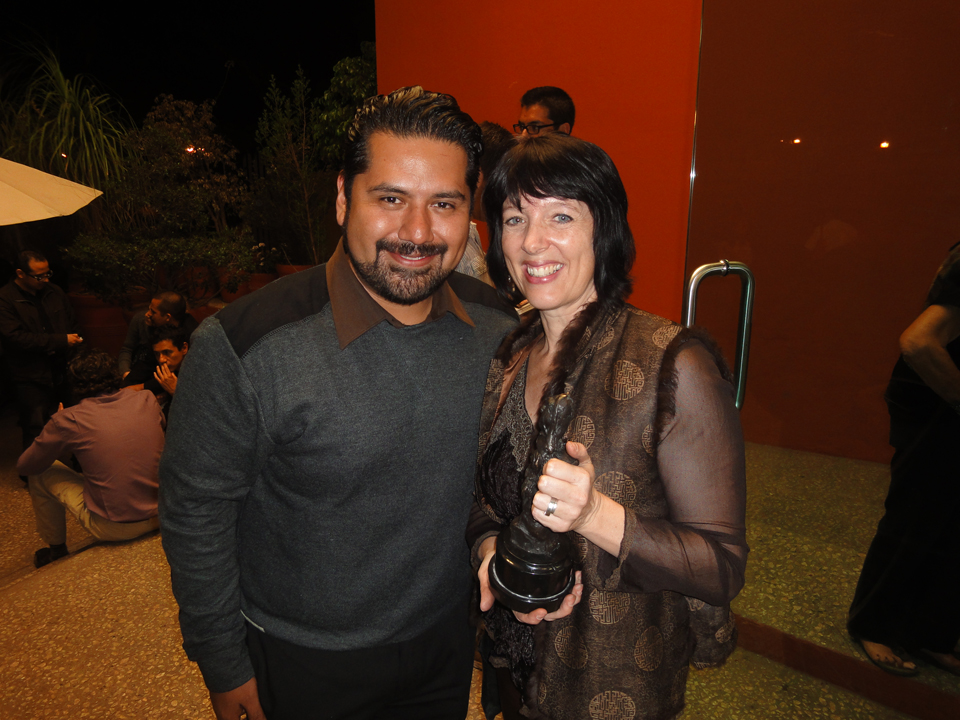 This is a picture of me with Felix Martiz, whose film was so popular at the Oaxaca International Film Festival in November that the organizers had to add three screenings. Four, actually, since Gary and I loved his “Santiago” so much we brought a screening copy back to Beaufort. The dialog and acting in this film is so fresh you feel like there is no script and that the characters are real people. We’ve screened enough independent films to know this is almost impossible to pull off, especially with low budgets. But here again Felix broke the paradigm – he made “Santiago” for $5,000 and a lot of favors. It helps that he just graduated from film school in LA and knew terrific actors just breaking into the industry. But it takes more than luck. Being able to convince people to work for nothing is where being a truly nice guy comes in. Which is another reason why so many filmgoers in Oaxaca lined up to meet Felix and see his film. Still, we weren’t sure Ron Tucker and his panel of screeners would feel the same way – it’s about a world that seems very far from Beaufort: Latin American immigrants and the street life of drugs and prostitution that sometimes proves hard to resist.
It turns out they were as blown away as we were and invited Felix to the Beaufort International Film Festival. Now it’s time to see if he feels the same way about Beaufort. He’s young, Mexican-American, never been to the South, an LA-guy through and through. His film is making the big festival circuit in towns that have multiple venues, late night screenings and even later night after parties. Beaufort will be quite the culture shock – and I’m betting in a great way. It’s an intimate festival, where a big chunk of the audience is retired and watches every single movie over the course of three days. And because it’s all happening in one venue – the USCB Performing Arts Center – filmmakers don’t have to miss each other’s showings to screen their own.
We’re picking Felix up at the airport Thursday and he’ll be at USCB’s Center for the Performing Arts in time to take audience questions after the 4pm screening of “Santiago.” Which should be interesting. The publisher of La Isla, Hilton Head Island’s monthly magazine for Latinos, is bringing a team of supporters and reporters. He’s fascinated by Felix’s film, not just because it deals with immigration, but because the immigrant experience in LA and here in South Carolina seems so very different. Felix’s next screenplay deals with unsafe working conditions of undocumented workers in LA factories. It’s the next generation of the immigrant struggle. In the world Felix writes about, borders have been porous and to some extent integrated, for generations. Here in the rural South, immigrants still live in migrant trailer parks, tucked away on places like St. Helena Island and Ridgeland. They’re isolated and targeted by anti-immigration bills like the South Carolina law La Isla is fighting with all the strength of the mighty pen it can muster.
One of Ron Tucker’s principal goals in organizing a festival every year is to entice filmmakers here to make films. Felix may end up being one of them one day, shining a light on people right in our own state who might otherwise remain invisible.
Screenplays, weddings and wine
I promise, my annual “don’t miss these films” blog about the Beaufort International Film Festival is coming soon. But in the meantime, I thought I’d whet your appetites for the second annual screenplay table-read event at BIFF. (Thursday, Februrary 16th at 7:30pm)
If you didn’t make it to last year’s event, or have no idea what a table-read is all about, check out this audio podcast my friend Burton Sauls has put together. It’s me, doing a 10-minute play-by-play of the excitement and controversy leading up to the inaugural table-read last year. (Burton is developing a series of these kinds of podcasts from various events and musings of Beaufort’s artists and citizens so potential visitors can “preview” this crazy place and hopefully come and spend lots of money on vacations.)
This year I’m lucky enough to have another screenplay in the finals, “The Wedding Photographer.” And although I won’t have to worry about getting struck by lightning in a church, this year’s table-read should be even more exciting. First, it’s going to be at USCB’s big theatre with the actors on stage. Second, there are rumors some movie-star types might read, although if we’re lucky enough to get the same Shakespearean actors as last year I’ll be just as thrilled. They’re that good. Third, the talented director Gary Weeks (an audience favorite two festivals ago with a dark, Georgia-based, post-apocalyptic film you may remember) has two screenplays in the read. And I’m pretty sure that I’m not the only local screenwriter this time – there are Hilton Head finalists I’m looking forward to meeting. Lastly, just like last year, the $15 ticket includes wine and all the questions you care to ask the attending writers (and they’re all attending).
So, about “The Wedding Photographer.” What fun it was to write a comedy instead of my usual, much darker fare. The idea came during our morning walk downtown when I saw an intensely uncomfortable young couple posing for what must have been an engagement announcement shoot. Gary and I both laughed out loud, because the night before we’d talked to our good friend Tom Kwas in Milwaukee. Tom once had a thriving studio photography practice in the Midwest and has made the most treasured photographs of our family through the years. He’s incredibly cynical and teases us mercilessly every time South Carolina or its governors are making headlines, but under all the witty sarcasm he’s the sweetest man on earth. So the thought of Tom, transplanted to the Deep South, making wedding photos of Southern bridezillas, cracked us up. And gave me the idea for a screenplay.
Having no first-hand experience in wedding photography, I needed to do some research. Which is where Susan DeLoach came to the rescue. She is one of the most sought-after wedding photographers in the area and she graciously allowed me to tag along to a few shoots as her “assistant.” I was amazed at the skill and talent involved, not all of it technical. Susan is part artist, part big sister and part therapist for stressed out brides and their families. Those shoots were invaluable in helping me learn the terms and process, but utterly useless for character development. You see, Susan could not be a better example of Southern etiquette and grace and my protagonist has to hate the South and turn into a wedding photographer who makes brides cry. Until, of course, he meets the right woman.
I barely finished the first draft of “The Wedding Photographer” in time for the BIFF entry deadline, so I’m sure that other finalist scripts are much more polished and deserving of the Jean Ribaut award. But I love my characters and the lessons the South teaches them all. The best part was setting it entirely in Beaufort and working in references to the people and places that make this place so unique. Harold’s Country Club, for example. If you come to the reading, perhaps you’ll recognize out a few more. And hopefully your presence and support will help convince one of the talented producers, actors or directors in attendance to actually consider making “The Wedding Photographer” happen.
The End of an Era
ETV of the Lowcountry goes dark today. Without any fanfare or public notice. Two more loyal employees will be filing for unemployment and South Carolinians will lose one more piece of our democracy.
It isn’t surprising that WJWJ got the axe. It, like all PBS stations, has been under fire since the 90s when then Speaker Newt Gingrich launched his Contract on America. The “liberal” viewers of “elitist” shows like “The Local News,” “Steppin’ Out,” “Lowcountry Live,” “Coastline” and “Aerobics with Amy” were somehow draining the economy of private sector jobs. Back then, ETV’s commissioners fought to save the station and held a series of sunset hearings in the 90s. Those hearings at TCL, filled to capacity, turned into a community love-fest and WJWJ was spared.
This time around, ETV knew better than to give the public warning. Unless you consider cancelling the only locally-produced program, our half-hour newscast, due warning. Layoffs began in earnest and the skeletal staff was thinned down to just two people. ETV’s idea was to make the station “pay for itself” through studio rentals to private companies who need production services. The only problem with that idea is that we the tax payers already paid for ETV and private production service providers have a legitimate beef with that. They couldn’t compete against an entity that already had salaries, equipment and light bills subsidized by the taxpayer. Luckily that program was so ineptly conceived that ETV’s rental rates were higher than local competition so it never did hurt private enterprise. But it could have.
I think Mayor Billy Keyserling knew that, and that’s why he asked me to convene a group of industry types to see what uses we could come up for the station. Public uses. Uses that might build a sense of community again. The resources were just sitting there, a beautiful studio, state-of-the-art cameras, even field equipment and a very talented producer/editor.
We found there was no shortage of people who wanted to use those resources, especially since we the taxpayers were already paying for them. Jane Upshaw invited the ETV head honchos down to USCB to hear our ideas. Essentially we proposed turning WJWJ into a TV-and-independent film incubator – where people with ideas for programs and documentaries could make trailers and seek funding. If those entrepreneurs found an audience, they’d agree to use – and pay for – WJWJ services. You should have seen the blank stares. The ETV management was so set on the idea of making the station “pay for itself” that it wouldn’t even entertain the suggestions of this industry-experienced committee. We didn’t even get a reply.
So it doesn’t really surprise me that they’d quietly kill the station and its last two remaining jobs. What does surprise me is how readily we, as Americans, let things like this happen. We have arguably the strongest democracy in the world, and that democracy is what allows capitalism to prosper. Without that democracy, we get the 1% and the 99%. And yet we are letting the fundamentals of democracy slip through our fingers. Who needs newspapers when we can read like-minded-opinions on Yahoo? Who needs public libraries when those of us who are still employed can just download books? Who needs public education when we can plunder that resource in exchange for a voucher and teach our kids what we already believe? Who needs the postal service when we assume everyone has email? Who needs public transportation when we assume everyone can afford a car?
I spend a lot of time traveling in Third World Latin American countries (it’s the only place I can afford to travel) and the United States is not far behind. Argentina gave up its railroads. Nicaragua doesn’t have a postal system. You can’t get a phone line in Mexico. Places that have given up on public education rely on missionaries and charity to lift their children out of poverty. Yup – we’re following in their footsteps. Closing WJWJ may be a sign of what’s to come – democracy going out with a whimper.
I’ve converted

Nothing strikes terror in the hearts of friends and family like a conversion announcement. I came out at a football playoff party at my dear friend Lolita’s house. Maybe it wasn’t the best timing – mid tortilla chip dip and all. But I blurted it out anyway.
“Gary got me a Kindle for Christmas and I love it.”
Lolita’s jaw dropped but she recovered fast enough to bust me on my own hypocrisy. “You said you were one of us!” meaning her literature-loving, book-club-belonging, close-knit group of friends. “I would feel better if you were converting to Catholicism!”
Lolita has nothing against Catholics; it was just the biggest about-face she could think of on the spot. (I am rather public in my secular-humanist, spiritual-but-no-formal-religion stance.) Like Lolita, I have always been adamant in my cuddle-up-with-a-good-book, feel-of-the-paper, musty-smell-and-all support of the traditional.
I blame my conversion partially on my cat, Rosie. Trying to read a “real” book with her in the vicinity was always a challenge. She is literally jealous of anything that prevents petting when she is in the mood for affection and “real” books are big and heavy and prevent guilt-inducing eye-contact between the species. She has batted books out of my hands, clawed pages and bared her teeth in the past. Thankfully, since the Kindle is not cheap, she has nothing against the e:reader. She actually purrs when I balance the Kindle on her side, or her back, or even that itchy spot where her tail connects. The only glare I get is when I have to turn the thing off and rejoin the working world.
But it would be rather small of me to not admit the other reasons I love my cozy little reader. Pointing at a word for an instant definition instead of having to look it up in a dictionary? Priceless. Hovering over a delicious phrase and having it “highlighted” for later lingering? Addictive. Reading a book review in the Wall Street Journal and being able to instantly download it and start reading? Good for the economy, if not for my checkbook. I’m buying new books again – for the first time since my friend Will Balk left the Bay Street Trading Company.
Don’t worry, Lolitas of the world. I’m not going to throw my old books in a bonfire and I’m not divorcing myself from all things non-electronic. I wasn’t required to sign an oath of allegiance and because I live with a photographer I’m certain art books will maintain their treasured status in our house. But forgive me if it takes a little longer to answer the phone on weekends. I’ll be purring with Rosie.
Oysters and Movies
There I was in the Cancun Mexico airport, hungry, with three hours to kill before flying home after a soul-nourishing Christmas vacation in Tulum. There’s nothing like a loud, fluorescently blinding, over air-conditioned airport terminal to kill the vacation vibe. I felt even sorrier for all the other travelers having to return to a miserable January in Minnesota and Wisconsin (their Packers and Vikings-wear gave them away, along with their sunburns.)
And then I spotted the Bubba Gump Seafood Restaurant near gate C18. It was an attitude check, however commercial, that I was lucky to be returning to a place so lovely it stars in movies like Forrest Gump. I confess it was my first time dining at the chain where you order your food by flipping a license plate sign on your table to signal waiters: “Run Forrest Run.” The friendly, mandatory, “How y’all doing?” was giggle inducing, coming from a young woman with an accent from much farther South. And then it happened. I looked up and saw a faux-country-framed photograph of my good friend, Marlena Smalls, on the front porch of a house on Lady’s Island. It was a publicity still depicting the moment before “Bubba’s mother” passes out.
She still looks the same, almost twenty years later, and so does the house. In fact it’s the location for this Saturday’s Beaufort International Film Festival’s fundraising oyster roast. For the price of two burgers at the Cancun Airport’s Bubba Gump restaurant, you can eat fresh Lowcountry oysters “on location” of one of Hollywood’s most iconic films.
There haven’t been many movies made in Beaufort since then, which is something the festival’s director is trying to fix. Ron Tucker has managed to get every filmmaker whose work is an official selection of the festival to actually come to Beaufort for the screenings. It makes for an incredible Q&A session after each movie, and more importantly, it exposes the most promising new filmmakers to everything that is beautiful about Beaufort. With any luck, and with better incentives from the state, they’ll end up filming future masterpieces here again.
Who knows, maybe one of them will direct my latest screenplay. It’s a romantic comedy called “The Wedding Photographer” and takes place in Beaufort. I won’t give the plot away (you’ll have to come to the screenwriter’s roundtable on Feb 16th to hear actors stage an excerpt) but you’ll get a taste if you come to the oyster roast fundraiser. The band playing as we all shuck oysters and eat chili is a local favorite, Kirk Dempsey and his Side Street Walkers. Guess who I’ve written into the final scene of my screenplay? So come on out and maybe you’ll be able to say you saw them play, at Bubba’s Momma’s house, before they made it big on the silver screen.
“Organics – the Art of Nature”

Some days I feel like an expat in my own country, especially during primary season in South Carolina. I weary of defending my choice to put down roots here, in the face of our governors and statistics. It’s tiring, remaining faithful. And then something comes along that lifts the burden of explanation.
It happened once before, when Joggling Board Press published “Transfer of Grace: Images of the Lowcountry.” Until that moment I was never sure that my husband could ever love this place as much as I do. I had dragged Gary, a Midwesterner, to meet Byrne Miller while he still could. The fact that a Jewish modern dance pioneer from Manhattan could survive in the Deep South helped, but didn’t convince him. When strangers on spring garden tours asked him what church we attend, I sensed his commitment wavering. That this town is still so divided: black and white, young and retired, uber-wealthy and just-scraping-by – didn’t sit well. But in the photographs on the pages of our first book together, I saw that he could put all that aside. I saw that it is possible to love a place in spite of itself. There is incomparable beauty in the Lowcountry, a value in any grace we leave behind.
If you go to the opening of “Organics: the Art of Nature” tomorrow night at USCB’s Center for the Arts Galley you will see even more evidence of my relief. It’s not just Gary’s work on display; he is showing with the fiber artist Kim Keats for the first time since they started collecting each other’s work. It makes sense – both artists use painstakingly intricate, even archaic techniques to make their one-of-a-kind creations. But the show is a continuum more than collaboration – on one end Kim constructs works of art from natural elements and on the other, Gary deconstructs nature into elemental shapes, tone and texture.

She calls her work salvaging nature; he calls his scavenging and simplifying. Together they elevate elements we normally overlook into objects to reconsider, and celebrate. It’s astonishing, the strength and resilience expressed in some of nature’s most delicate, even fragile parts – a robin’s egg in a tiny but protective nest, peels of bark lashed into sturdy crossings.
I take partial credit – after all I am the one who dragged him here. And I tolerate all the dead and decaying things he now drags into Byrne Miller’s house to photograph. It is proof, to me, that the Lowcountry is finally under his skin.
More than an award…
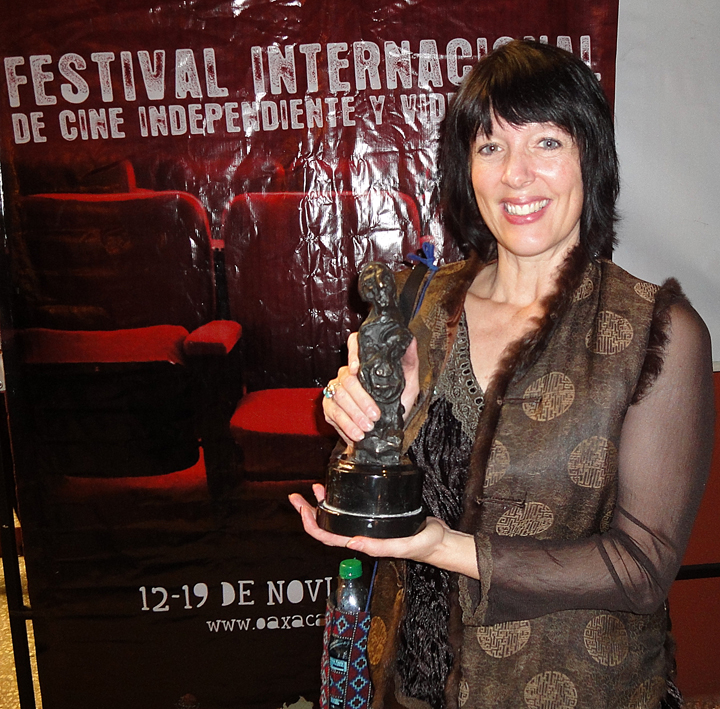
A writer should probably enter a film festival to advance her career, meet people in the business, hopefully add an official selection logo to her resume. But I confess: I entered the Oaxaca International Film Festival because I saw that the trophies for best film and best screenplay were statues by Alejandro Santiago — my favorite living artist ever.
I am not alone in this opinion. According to the director of the Oaxaca International Film Festival, Ramiz Adeeb Azar, the Mexican government asked Alejandro Santiago to sign papers saying it’s okay to put his face on money or stamps after he’s dead. (Diego and Frida are on the five-hundred peso note now.)
I first read about Alejandro Santiago in Raw Vision – an outsider art magazine that celebrates the likes of Thornton Dial and Sam Doyle. I found it a little strange, as if simply because he’s from a small village in Oaxaca, Santiago is somehow an outsider. I can’t think of anyone more connected to his art, to his culture or to the human condition. Consider the seven-year project that vaulted him to fame. He came back to Mexico from living and painting in France and found his entire village empty of men. That’s the flip side of the immigration story we hear in the United States. Women and children hanging onto the thread of hope that their men will make it safely to the other side and someday return.
There are no less than three documentaries you can watch about the project, http://movies.netflix.com/WiMovie/2501_Migrants_A_Journey/70147461?trkid=2361637 but the art-world narrative goes like this: Alejandro Santiago had a dream, and in that dream he repopulated his village. The way he made it whole again was to acknowledge the absence. Seven years and a million dollars later there were 2,500 statues representing the migrants, plus one – himself. There were exhibits along the Mexico/U.S. border – all 2501 figures facing Mexico, yearning, and later in museums and galleries around the world.
The story wormed into my heart and never left. My own childhood was so nomadic that I’ve never felt the rootedness of Santiago’s “migrantes.” For years I’ve tried to see them. It became almost a pilgrimage. Gary and I have visited Oaxaca six times, combing through its world-class galleries, even renting a car to try to drive to the village where Santiago made the statues. But it turns out maps in Mexico are as abstract as its contemporary art. We found other works by Santiago — fantastic, unforgettable drawings and paintings I’ll never be able to afford – but not the migrantes. What we found instead was an entire culture of artistic expression, an explosion of stories put down in clay, on canvass and spray painted on the walls of Oaxaca in protest. I realize now that Mexico was making me pay my dues – when the student is ready the teacher will come.
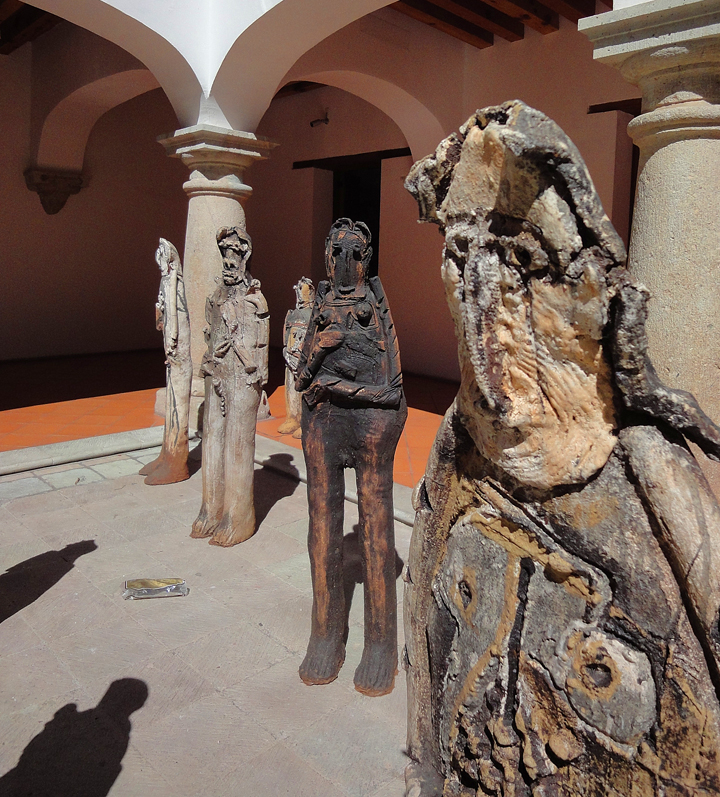
Thanks to the Oaxaca International Film Festival, I am closer than ever. On the mornings before the film screenings began, we wandered Oaxaca’s museums again and found a group of Santiago’s migrantes finally on public display. I stood as still as the statues, suppressing the urge to touch them.
And then, on the last day of festival, Ramiz and his wife Diana invited us to a special screening at the artist’s home. As if making the trophies wasn’t enough, Alejandro Santiago opened his own home for a kid’s night – spreading out straw palapa mats on the ground and projecting all the winning animated films on a white courtyard wall. Seeing more migrantes there, in the humble outskirts of Oaxaca where Santiago still lives with his wife and children and seamstress mother, is something I’ll never forget. They appear to be walking out of a jungle. They stand in silhouette atop a corner of an adobe wall. I realize how deeply he must still feel their absence to surround himself with the presence he willed into existence. Which is only a fraction of how deeply their absence must be felt in families all across Mexico – sons, uncles, fathers and husbands offered up, prayed over, ached for.
Someday, when I’m more experienced and worldly, I’ll have an elegant speech prepared in the event of winning a major award. I was thrilled to win best screenplay for “Mask of the Innocent” and ecstatic that my first big festival win was for a female-lead thriller set in Mexico. But on Saturday night, on the stage of the beautiful Teatro Juarez, I didn’t say any of that. I was holding a piece of the Mexico I have come to love.
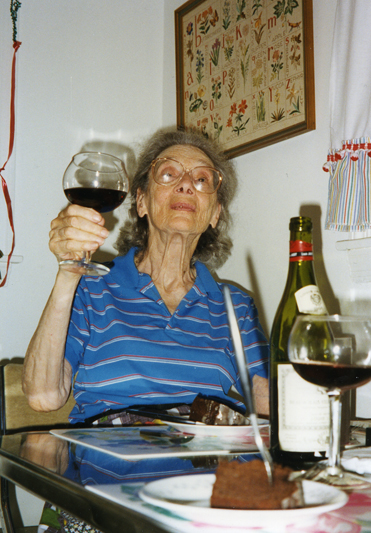
Happy Birthday, Byrne

- A long ago toast
Frogmore Blues
Just a quick update from Sweet T. That’s my blues name, you may recall, coined during our road trip down the Mississippi Blues Highway last winter. Turns out we don’t have to drive all the way to Clarksdale to hear gut-bucket blues. Not since Kirk Dempsey came back from the blues clubs of Atlanta to the tomato fields of his childhood in Frogmore, South Carolina.
Kirk isn’t a white-boy, copy-cat kind of blues musician. He grew up picking tomatoes on his dad’s farm just up the road and puts his own Lowcountry growl on artists from Woody Guthrie, to Johnny Cash, to Tom Waits. A little bit washboard, a little bit honky-tonk – when Kirk’s Side Street Walkers get riled up you realize most every song you really love was inspired by the blues.
Tom Davis – the electric banjo player, not the politician – felt the pull all the way from California. Tim Devine brought his Fender Telecaster from a city no stranger to bluesmen – Kansas City. Alan Webb, the group’s transcendent washtub bass player, says anybody who can dance can feel the rhythm of the blues.
With Kirk it goes back further than most. About halfway through the second set, he puts down his harmonica and breaks into gospel with “John the Revelator”. He does it the way he remembers from the pews of St. Helena Island’s Brick Baptist Church – call and response style – only this time he’s playing the role of the preacher.
Not that the crowd Wednesday nights at the Foolish Frog needs much converting. Last night there were two town judges in attendance, a couple of locally renowned artists, a ponytailed landscape gardener and a few bearded carpenters clapping along with folks visiting gated golf course communities. The blues brings all kinds of people together and puts us in our place, like no other music can. You can’t really argue with a deadpan pronouncement by a 60-year-old bass player who made his own instrument from an old boat oar and the plastic cord of a Weed Wacker.
“I would like to add that we are good for the digestion.” – Alan Webb. 10/19/2011
Yeah. What he said. Maybe that’s why the Smithsonian’s music exhibition “New Harmonies” lined up Kirk and his Side Street Walkers for this Monday’s lunchtime concert at the USC-Beaufort Auditorium. For those blues-lovers too down-on-their luck to drive all the way to Frogmore.
Saying goodbye…
A memorial service for the artist Suzanne Longo is tomorrow morning at ten, at the Beth Israel Synagogue. We’ll be saying goodbye, but all I keep thinking about is the last time we said hello.
I remember that sunny morning because she made me laugh. Gary and I were on our walk, down by the Waterfront Park playground, when she popped out of nowhere. Actually, she popped up from under the bridge to Lady’s Island – a shortcut she cheerily reversed to show the two of us how you can duck under the line of cars waiting for the swing span to close and practically tiptoe over the edge of the Beaufort River.
Normally an artist in her early sixties popping up from under a bridge might startle me, but this was Suzanne Longo. Ever since I met her in the early 90s, she’s been popping up in unexpected places and ways.
I was a rookie reporter just arrived from the West Coast and she was a mysterious artist transplanted from New Orleans. So exotic that she named her gorgeous sons Moon and Star! The occasion was a kerfuffle over one of her sculptures – a bench that prominently featured the mounds of the female form – right across Carteret St. from a church! I don’t know which one of us thought the story was more ridiculous, or funny. Beaufort takes getting used to.
What will be even harder to get used to, is Beaufort without Suzanne.
 "TeresaBruceBooks"