What I did at Camp Hollywood

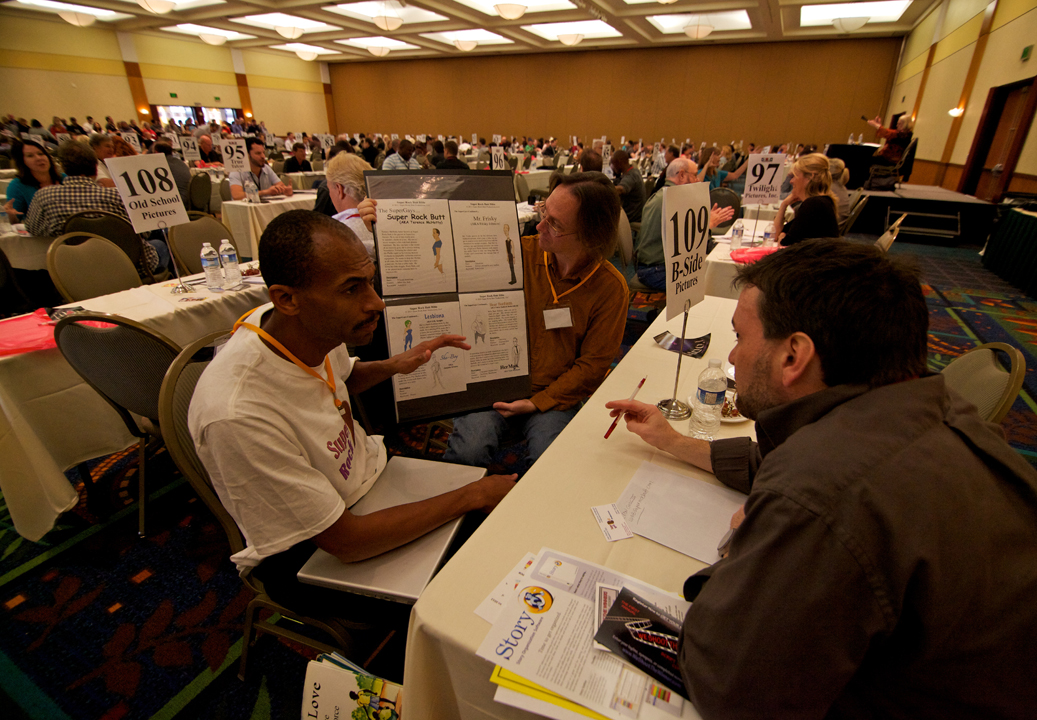

They say screenplay pitch festivals in LA are a lot like speed dating. Not having tried seducing anyone before a five-minute buzzer cuts me off, I can’t actually vouch for the analogy. But there was a woman with a cow bell. Literally, at the Great American Pitch Fest in Burbank Sunday, a 50-something woman presided over a cavernous convention center hall with a cowbell. Which she rang, with Christopher Walken enthusiasm, every five minutes, for six hours.
You’d think, given that her job was to keep five hundred would-be Nora Ephrons and Judd Apatows moving right along, she would signal your time’s up with the clap of a sync slate. Or a flashing red applause light and canned clapping. But the cow bell was the perfect cue. We were, afterall, being herded — shuffled out a side gate to what organizers affectionately called the bull pen, to wait in line to do it all over again.
Waiting in line was the most entertaining part. It’s where I met a woman from Texas, I’ll call her Lanky, who wasn’t satisfied pitching her epic to the 120 production company execs there to listen in five-minute increments. She had to pitch me too – how the one true God was still to come and we’re all just circles of light waiting to receive the signal. I think her movie was the signal, but I didn’t really want clarification.
Then there was the couple in their sixties who carried around a miniature Siberian all day. I had to ask. The dog was part of the pitch. Again, no need to know more. Those lines were long and once a conversation like that starts it’s hard to stop.
I liked the whisperers the best. Nervous writers, mostly from other parts of the country, who kept reciting their pitches to themselves in line. This is when you’d think blue-tooth headsets would be a good disguise. Except when you still whisper. Kinda gives you away.
Like the woman from North Carolina, who bonded with me because we’re both from states that end in the word Carolina. She looked nervous, so I told her she looked like Isabella Rossellini. She told me that her screenplay was a riches-to-rags story, about how she and her apparently unlucky husband had to leave New Jersey and wound up in the sticks. (Charlotte – her description, not mine) Then she took a cell phone call from her husband, who told her that her whole church was praying for her. Right at that very moment, three time zones away.
“I’d lead with that when you pitch those producers,” I suggested. “You might be the only writer here with God on your side.” She fiddled with her pearl necklace and replied, “Right, and have everybody here think I’m a hick?”
I really felt for the couple from Japan pitching an animated short film. Which they’d already made. What they needed was distribution, and maybe a translator who could have explained they were playing in the wrong sandbox, wasting their time and energy. They looked dazed and disappointed, like I’m sure I did at my first pitch fest, when I found out that nobody in Hollywood wants to buy dramas unless they’ve already been a best-selling novel.
“But what about all the Oscar nominated dramas?” I sputtered – back in October. Then I checked. They’re always adaptations. Turns out my first two screenplays are destined only for “good-for-you” film festival awards.
This pitch fest was more productive. I took what I learned at the first one, swallowed my pride and spent the next four months creating something commercial. Which also turned out to be way more fun – both to write, and pitch. I had no trouble describing my R-rated, female-lead comedy, called “Free Corona,” before the cow bell rang. Although now that I’m back home I keep wondering if I should have had an actual Corona in my hand. Or better yet, one for each of the patient executives who had to listen to Lanky’s epic before they got to me. R-rated comedy and free beer … maybe that writer from Charlotte would have sent some prayers my way.
Love is believing, when editors don’t
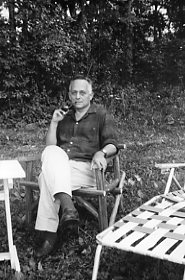
- One of Byrne’s favorite pictures of Duncan
One day I will write the greatest love story of all time, because it will be about the love affair between Byrne and Duncan Miller. It will not be a sappy romance, or always happy. But as everyone who ever witnessed the magnetic field between them will attest, it will be riveting.
Just a tease then, of that someday story, drawn from what might seem to be a trivial detail. When I was in my twenties, Byrne told me that an established New York editor once compared Duncan’s writing to that of Thomas Mann. I had never read the Nobel-prize-winning German writer so it seemed a bit of unnecessary name dropping at the time. I had no need of external validation – I never doubted Byrne’s biography of the husband she adored. He had been a copywriter in Manhattan’s golden age of advertising, grown tired of copy writing and dedicated the rest of his life to novels.
Byrne and Duncan’s first “date” was a meeting of a writer’s group in Manhattan that Byrne joined to improve her technique. Duncan walked her home and over the course of the fifty city blocks, convinced her to quit the group because real writers don’t need groups. He also convinced her to marry him.
Their sixty-year romance was well chronicled in the journal Byrne kept for her two daughters, now housed in the Special Collections of the Beaufort County Library. “Duncan and I agreed that we each should have a chance at a career,” Byrne wrote. “He would have first try – writing at home while I earned the money.”
The next part, to me, is the very definition of love. “I edited his day’s writing and re-typed it. In ’34, Duncan submitted his “Sit in Dark Palaces” to the Atlantic Monthly. It did not win the prize, but one of the ten big editors said he’s the only one this side of the Atlantic Ocean writing like Thomas Mann.”
By the time Duncan died, Byrne had edited and re-typed six complete novels by Duncan, all of which ended up in bankers boxes under the home-made sofa in their living room – unpublished. There were also hundreds of rejection letters – the early Thomas Mann glimmer of hope was the only one of its kind.
I’ve always wondered how she did it, how she kept encouraging Duncan through six decades of disappointment, how that single reference to Thomas Mann managed to keep them going. So this year I read several stories and novellas by Thomas Mann, searching for similarities to Duncan Miller.
“A writer is somebody for whom writing is more difficult than it is for other people.”– Thomas Mann
What I found is that that anonymous editor didn’t lie. In his attempt to let Duncan down gently, he may have encouraged a lifetime of futility but there are similarities. They both wrote in many modes: Mann from everyday realistic to surreal, Duncan from political to paranoid. Both were heavily influenced by Nietzsche, Mann so much that he rarely abandoned the theme of the artist as outsider, “a dubious figure, a creature of sickness and longing for death.”Duncan shared with Byrne what would become her favorite quote. “Life is hard to bear, but do not affect to be so delicate.” – Nietzsche.
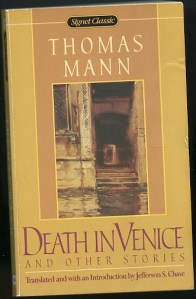
A major theme in Mann’s work is homoeroticism. The scholar Jefferson S. Chase describes “Death in Venice” as based on a true-life, same-sex crush Mann developed while on a vacation with his brother and wife. He never established a clear moral position in regard to homosexuality. Neither did Duncan. Byrne wrote that the first of his six novels, “Sit in Dark Places” was the story of a boy with a sexual love for his mother. His final novel, “Regiment of Woman” was about a soldier who had a sex change to prove that women feel more than men. In a handwritten note Byrne asked, rhetorically I presume, “What does all this add up to?”
The answer wasn’t the one she wanted. Byrne said her one regret in life, was never getting Duncan published. I think it telling that she didn’t describe this regret as never seeing Duncan published. But I suspect Thomas Mann would understand.
“A man’s dying is more the survivors’ affair than his own.” – Thomas Mann
Dancing Bishops
It took me longer than I expected to finish Willa Cather’s “Death Comes for the Archbishop.” I am not a fan of priests, nor do I have any history with the American Southwest. The only connection I have to Santa Fe, where the novel is centered, is borrowed from Byrne Miller. She lived there in the 1960s, a hundred years after the priests that so intrigued Cather. I wonder what they would have thought of Byrne: a modern dancer from Manhattan, Jewish, uninhibited, radical and experimenting with open marriage.

I suspect they would have been no more astonished than the Native American students Byrne took under her wing. Here came a tall white woman who walked even taller, confidently aware of her shapely legs and jutting breasts. She wore cat-eye glasses and scraped her jet black hair under silk scarves, except when she posed for publicity photos – wild-haired and wilder-eyed.
When she guest-lectured for a class called “Man and his Arts” at the Navajo Community College, students wrote thank-you letters about how she made them aware of their posture. When she taught dance at the Rock Point Community School, the Title IV Coordinator would later become one of her adopted sons: Benjamin Barney. Her class consisted of nine adults, two little girls and five onlookers – probably their mothers. Ben’s own mother might have been among them; she was deeply suspicious of dance as entertainment. Which might explain why in her journals, Byrne wrote of showing dance films, leading improvisations like “walking through phone booths” and emphasizing movement as a “teaching tool.”
I always found it odd, maybe even a tad imperial — the thought of a modern dancer from New York, teaching dance to a people whose very religion celebrated it. Dance came long before the priests in Willa Cather’s novel:
“The Bishop stood watching the flowing, supple movements of their arms and shoulders, the sure rhythm of their tiny moccasined feet, no larger than cottonwood leaves, as without a word of instruction they followed the irregular and strangely-accented music.”
I wonder if, at the time, Byrne watched as much as she demonstrated. She could be terribly intimidating, as my brother-by-Byrne attests. Ben was one of her best dancers but dance, in his culture, is a vehicle of faith. Movement is literally transformative. Byrne wanted him to wear tights and perform on stage – for strangers. She choreographed a role for him in a piece she called, ironically, “The Walls Between Us.” Against his mother’s wishes, Ben danced for Byrne.
It still haunts him. He writes letters to me, helping with the memoir I am writing of my own time with Byrne. “The performance happened, even when I felt bad about it.”
It circles back to Cather and her Bishops, the novel that made me slow down and study the rhythm of the words. Byrne’s journey was no different than that of any outsider. The bishops had to pay for their awakening in years of travel – by horse, or burro, through Mexico new and old. Understanding wasn’t a souvenir. Byrne was much luckier. She collected children who grew to love her, faults and all.
Wind and Willa
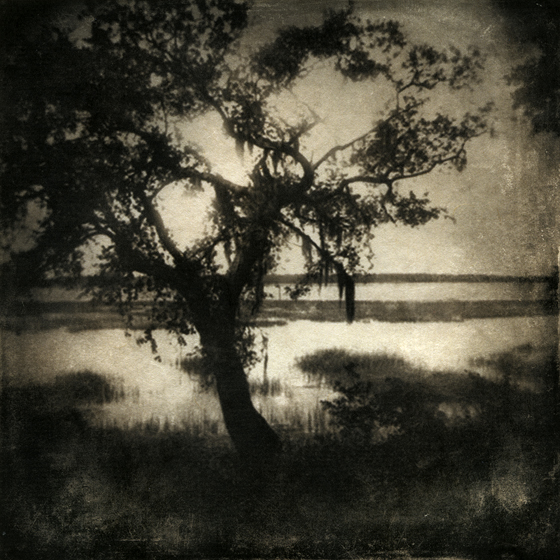
Blustery days put me on edge. The South Carolina Lowcountry isn’t supposed to be wind-whipped but today the seasons are battling it out on the banks of the Beaufort River. The water is the color of Spanish moss flailing from the massive boughs of Live Oaks. I can’t relax, settle into my thoughts, with palm fronds scraping the window. And I’m not sure why.
When I lived here with Byrne, I could always toss these questions into the air between us. There would be wine, on the porch, and maybe a sliver of cake. And stories, always hers, that I scoured for meaning. She was confidant and fortune teller. I could interpret my life through hers.
Now that she’s gone, I unravel truths from books instead. I wrap the ideas of other writers around my shoulders, seeing how the words fit. Like these, from Willa Cather’s “Death Comes for the Archbishop.”
“It was the Indian manner to vanish into the landscape, not to stand out against it,” she wrote. “The Navajo hogans, among the sand and willows, were made of sand and willows. None of the pueblos would at that time admit glass windows into their dwellings. The reflection of the sun on the glazing was to them ugly and un-natural – even dangerous.”
I have tried to change the landscape, living in this house that Byrne and Duncan Miller loved. Hiding behind its windows and walls, I pretend that all I see is permanent and predictable. Something I can draw from, and write about, at will. The wind reminds me I am an intruder.
One of Byrne’s first adopted “children,” a Navajo elder I consider my brother-by-Byrne, if not by birth, wrote a letter to me when he found out I was writing a memoir of my time with her. We were planning a reunion, here in the house he had visited on momentous occasions in Byrne’s life: major dance concerts, anniversaries, memorial services. One line in his letter has confused me, until today.
“At times I want to see the house and the trees again, but did not know ways to them.”
My brother-by-Byrne sees himself as walking through landscapes, not discovering or claiming them. What matters are the memories and feelings they evoke. The path is not one he controls. He is at peace with that. I sit at my desk and wonder when the wind will stop and I can settle into certainty again.
I didn’t get struck by lightning!

Tables, in Beaufort, South Carolina at least, have better reasons for existence than for actors to sit around them reading. As soon as director Bruce Doneff realized that we were going to have a big audience for last night’s table read of the Beaufort International Film Festival screenplay finalists, he made an executive decision. The microphone-less actors were going to have to stand and project. So he moved the table from the stage to the back of the house, draped it in lovely black fabric and stacked it with bottles of wine. It was one of three great decisions he made.


The second was to invite the actor Benjamin Busch down to the front row and get him to explain how table reads usually work — to the players and the audience that quickly filled in from the French film next door, once word of the wine got out. When dozens of film buffs aren’t paying $15 each to hear unpublished screenplays read aloud for the first time, table reads are apparently intimate, intimidating affairs. Usually only the writer, director and producers are in the room with the actors, who’ve never seen the script before. It’s when writers discover that dialog falls flat, directors discover they need more rehearsal time and producers discover that some cast members just aren’t going to click and need to be replaced.
Thankfully, ours was nothing like that. I’ll take a crowded audience of film buffs with glasses of wine in their hands any day. They didn’t seem to mind the tradeoff of conversational delivery for actually being able to hear in the back row. But I was nervous. I’ve sat, mumbling the dialog of my screenplays to myself, in front of my computer, for days. I rarely project. I never use body language. I don’t use high voices for females and my best Johnny Cash for males. So watching the rehearsal was like watching a Shakespearean adaptation of my dark, disturbing drama. It worked brilliantly for the screenplay before mine, about moonshiners and revenuers, but would it ring true on a modern-day drama about a sex offender?

Which brings me to the third great decision Bruce Doneff, the evening’s director and MC, made. He announced a five-minute intermission before my screenplay and encouraged everyone to get another glass of wine. His hope was that a good buzz would make the adult language in “The Scarlet Registry” easier to swallow. The actress who volunteered to play my protagonist’s wife, the brave and talented Suzanne Larson, had the distinction of dropping the first F-bomb in the festival’s history. Did I mention that the theatre is actually owned by a church, which holds services there every Sunday?
So I had a glass of wine myself, then got up in front of more people than I ever expected and gave the set-up for the excerpt. I didn’t go into a lengthy explanation of how it came to be, or warn the one 14 year-old-in-the-second-row-I-had-never-seen-before! about the subject matter. And because I didn’t muddy the waters, I had the most surprising revelation.
The first scene the actors read from, the one where a young girl sees her father doing something no girl wants to see, was unintentionally funny! If I hadn’t heard a real live audience laughing I wouldn’t have believed it. I was racing through possibilities – I should give the protagonist a more serious name, change the scene descriptions to avoid slang, definitely eliminate the girl screaming. But afterward, the director of a brilliant short in the festival, Seth Boggess, gave me something else to think about. He liked the fact that the scene came across as funny. He said the other scenes are so dark it needed some comic relief. And he might be right. It certainly jives with what the up-and-coming production company types told me in LA.
I know the screenplay needs work; all writing is re-writing, right? And yes, Busch was right. There’s nothing like a reading to show where I’ve given characters too much exposition. But the table read was just the motivation I need to keep going. The audience seemed to “get” my attempt to create nuanced characters and they asked good questions.

And the best question of all came from one of the filmmakers debuting her film this year at B.I.F.F: Natasha Warloe. She’s always looking for new material, would I let her read the whole script?
Debut of my screenplay at B.I.F.F.

It’s official – the Beaufort International Film Festival is underway and tonight it launches a new event: a table-read of the five finalists for best screenplay. I’m actually stunned that mine made it in – it’s a dark drama with a very unlikely, un-likeable protagonist – a father who winds up on the internet Sex Offender Registry.
“The Scarlet Registry” was my second attempt at writing screenplays, and back when I wrote it I didn’t know that dramas rarely sell, unless they’re adapted from best selling novels. When I pitched it at a pitch-fest in LA last October, I got some strange looks. One production company rep asked me if I’d thought about exploiting the humor in a guy essentially wearing a modern day Scarlet Letter. Uhm, no. Can’t say that I ever did. Another young agency staffer interrupted me halfway through the pitch. “Ooh Ooh,” she said. “I bet I know what happens. He’s really a computer genius and hacks his way into the registry and erases all the evidence.” I didn’t have the heart to tell her my protagonist, who was wrongly accused, ends up killing himself and the son he leaves behind develops a relationship with an on-line predator.
Thankfully all this didn’t scare whoever judges the screenplay entries for the Beaufort International Film Festival. And when Ron Tucker, who runs the festival, came up with the idea of staging a table-read so that audiences can see what a script is all about, he didn’t bat an eyelid either. I told him the theme is, well, dark would be an understatement, and that with a topic like sex offenders you’re bound to have adult language. I offered to let the actors substitute words as they saw fit. Afterall, the theatre where this all happens is owned by a church which holds services there every Sunday. I couldn’t believe how open-minded everyone was.
And then I had to go and blow it in an interview with a terrific local newspaper, the Lowcountry Weekly. As I’m sure I’ll be asked tonight, the reporter wondered why I wrote the screenplay. I hadn’t thought about it for a long time and blurted out that I’d known three men I thought had been wrongly accused. Their lives were ruined and now, with the advent of the internet registry, a false accusation is like being on a No-Fly list. Everyone thinks you’re a terrorist. Not exactly the most intelligent answer I could have given. It’s true, I do know three men I believe were wrongly accused. But I made it sound like that’s the norm. It isn’t.
And I was reminded of that by a wonderful young actress who had been cast to play my protagonist’s wife. Turns out her day job is a victims advocate. My screenplay is set in Florida but in South Carolina, where she has done far more research than I have, she’s found that it’s rare that a sex offender even goes to trial, let alone gets wrongly convicted and listed on the registry. She couldn’t, in good conscience, play the role of a wife who doesn’t believe the victim. Especially a victim who is a child. It’s too close to what usually happens.
A wonderful stage actress, Suzanne Larson, agreed at the last minute to step in and play the role of the conflicted wife. She, and the actress who refused, are my new heroes. The table read hasn’t even happened and I’ve learned so much from both of them. What I should have said to the reporter is that I am a writer. Drawn to the extremes of the human condition, not the norms. I wanted to explore the most dramatic theme I could think of. What could be worse than a man wrongly accused. Who can’t handle the unintended consequences of the registry. Who isn’t smart enough to defend his family or strong enough to think of a way out, other than suicide. Whose ultimately selfish action leaves behind a vulnerable son, who becomes the perfect target for online predators.
I’m a big fan of John Patrick Shanley’s “Doubt” – and how I was never really certain who was innocent or how you define it. That questioning, that nuance, is what I was shooting for with “The Scarlet Registry.” It may never have a shot in Hollywood, but I tried to have each of my characters twist and turn and eventually grow. Tonight, I’ll be a little closer to finding out if I succeeded.
Another short worth playing hookie for…
Screening entries for a film festival like Beaufort’s is brutally anonymous. As in, I knew nothing about any of the hundreds of filmmakers who submitted their work this year. Not their back stories, not how many other festivals accepted their films, not their “American Idol”-like tear jerking testimonies of near-death experiences and how much it all means to them. Some entries were hand scribbled on the DVD itself in Sharpie and I couldn’t even read the handwriting. That’s the way it should be. It’s how festival-goers know that the films that made it through to the finals and begin screening on Thursday got to Beaufort strictly on their merits.
Among the ones that sailed through, easily one of the best shorts I’ve ever seen, was a piece called “Left Alone.” Here’s why. Shorts are incredibly hard to pull off. They have to have the clearest of concepts, the tightest screenwriting, to work. They don’t have the luxury of 90 minutes to convince you or to tie up loose ends. Most shorts try to say too much, cram too many stories into too few minutes.
“Left Alone” started with a short story, a smart move. Even smarter, it’s a story by Anton Chekov. About a man dealing with grief that no-one else has any reason to share. Which, when you think about it, is easier to write about than to show, on screen. But the filmmakers who came up with the adaptation “Left Alone,” found the perfect vehicle. Literally. A modern-day taxi cab. And a driver who can’t accept the anonymity of his loss. It’s brilliantly acted, and beautifully shot and scored. It was the only entry of all the hundreds I screened that left me in tears. It’s that universal and yet that personal. By a certain age, we all meet grief. And the world doesn’t stop to let us off. Life around us goes on, whether we like it or not. On the strength of its ability to share that story, “Left Alone” became an instant finalist in best short film category of this year’s festival.
A couple of hours ago I read Mark Shaffer’s interview with the man who directed “Left Alone:” Seth Boggess. The veil of anonymity was lifted and I saw the context behind the film that so moved me. It turns out there’s no way I couldn’t have liked this film. First, it’s premiering here, at BIFF. Way to make a statement about the value of small festivals! Second, it’s made by a husband-and-wife team, Boggess and producer Natasha Warloe, both of whom are making the trek from Chicago to Beaufort for the entire festival. (Not that I’m prejudiced or anything, but my favorite projects are those I embark upon with my husband and partner.) The lead actor is a Steppenwolf veteran, no wonder he was amazing. And to top it all off, the music that put me right there, in the front seat of the driver’s grief, was composed by the director himself. Creating scores for movies is his day job. If only a screenplay of mine someday is set to music by Boggess.
In the end, film is never anonymous. Or the work of just one person. When we buy a ticket at the Cineplex it’s after a huge marketing blitz that is almost inescapable. But when a film like “Left Alone” can stand alone, without the benefit of any prior assumptions, that is raw talent.
Friday night at the Film Fest
Hello again, doing double-duty guest blogging for the Lowcountry Weekly’s FilmFix this week. Hopefully I’ve already convinced you to go to the Beaufort International Film Fest on opening night (Thursday the 17th.) The lovely French, non-terrorism-related film “Ich bin eine Terroristin” shows at 5pm and then you can stick around to heckle me at the screenwriter’s table read.
Thursday night’s not the be-all, end-all though. There are three full days of BIFF and I’ll be calling out those films that deserve special attention. Or that might sound unappealing but shouldn’t be missed. Friday night’s been getting a lot of great press, thanks to local filmmaker Michael Givens’ “Angel Camouflaged” that shows at 6:45pm (on two screens, I’m told, that’s how excited people are about this rock-and-roll musical.) And a powerful film called “A Marine Story” takes on Don’t Ask/Don’t Tell at 9pm. But in all the hoopla, don’t miss a gem that airs a few hours earlier, at 5pm.
“Bright” is a long short, 40 minutes, the kind that I really hope gets made into a feature film one day. It sometimes happens. Neill Blomkamps “District 9” started as a short that blew audiences away at film festivals. Benjamin Busch has an unusually contemplative touch, his film is a piece that you feel as much as you see. I won’t give away the plot, but it features really good actors of gritty, HBO-series fame, working with a mysterious, almost cryptic script. You can read the full review on the Lowcountry Weekly FilmFix blog, but if you want a sense of how talented and dedicated Busch is – all you have to do is read the comment he left on this post. That’s the cool thing about the Beaufort International Film Festival – it’s cozy and intimate and unpretentious. And you just might discover the next Neill Blomkamp.
What not to miss at B.I.F.F.
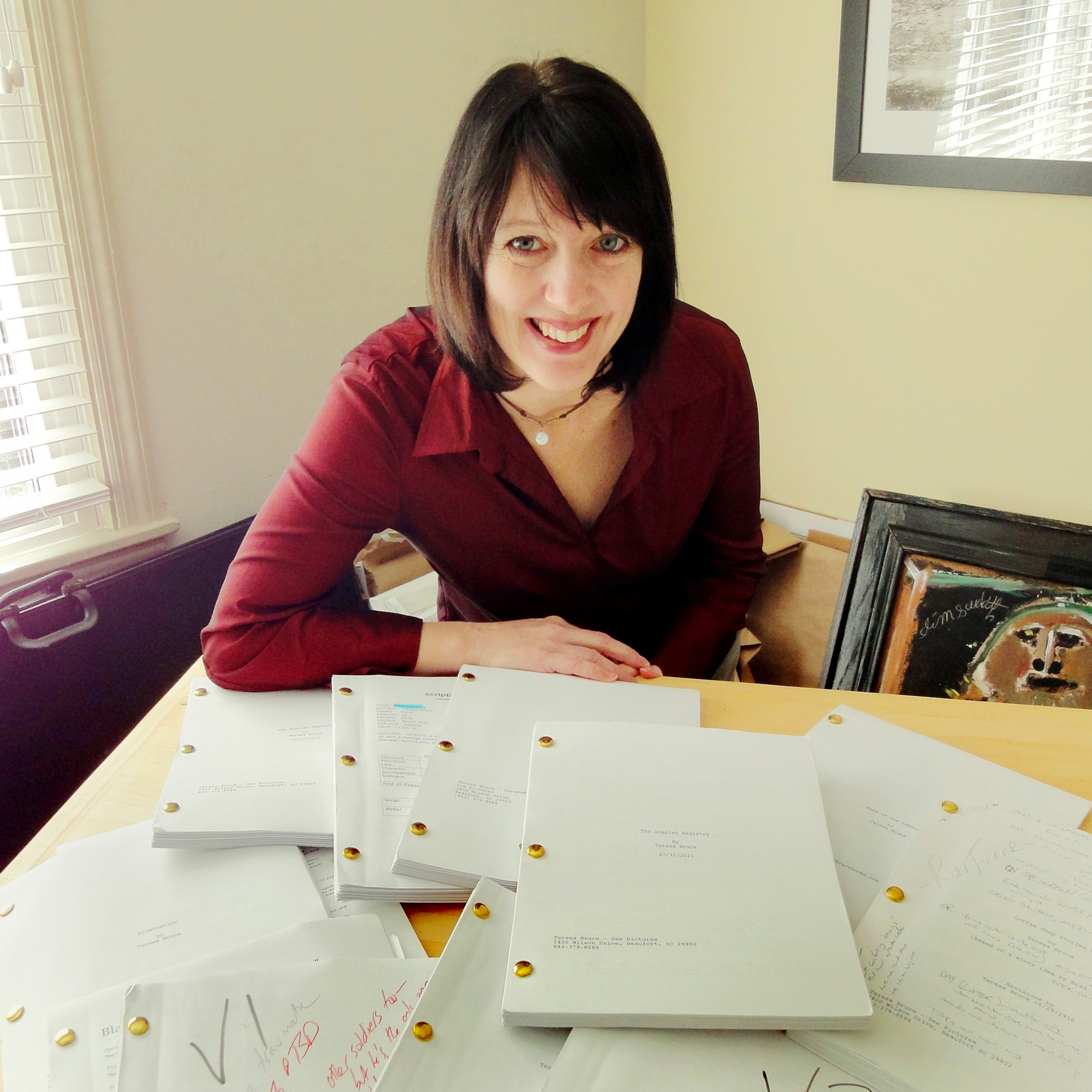
When Mark Shaffer asked if he could interview me for the Lowcountry Weekly, I didn’t know what I was getting myself into. It sounded innocent enough. One of my screenplays was selected as a finalist in the Beaufort International Film Festival and this year, BIFF is honoring writers by having Shakespeare actors stage a table-read of their work. (Thursday, February 17th, 7:30pm, wine-and-cheese, all at the Lady’s Island Cinema. I can’t wait)
But it turns out publicity comes with a price. I had to get Gary to take a new photo of me, one that actually relates to screenwriting. And Mark roped me into blogging about the film festival for the LCW’s new blog: FilmFix. Actually, it works out great, since many of you have been asking for recommendations about which films to see. There are 34 films this year and Gary and I got to screen them, plus the hundreds that didn’t make the cut. They’re all good, but some might not jump off the printed schedule and grab your attention. When they should. Like the confusingly named “Ich bin eine Terroristin.”
It’s one of my absolute favorites and it premieres right before the table read on Thursday night. So here’s what I wrote about it for LCW:
“It surprised me that I fell so in love with the independent feature “Ich bin eine Terroristin.” Despite the title it’s a French film, with English subtitles. Watching a film so enchanting you can barely stand taking your eyes off the young actress to read clunky words at the bottom of the screen is torture. Especially for someone who loves hearing how words on a page sound when they’re spoken. In a dark theatre.
I wish I spoke French. I know how hard translation work is. I’ve had to direct the translation of my own commercial films into thirteen languages and trust me, even the experts argue and bash heads over getting it exactly right. Which is why I’m astounded by “Ich bin eine Terroristin.” I didn’t nit pick. I didn’t second guess a single frame. I was there, in the story, mesmerized from word go.
Whoever cast the young heroine of the film, Violetta, deserves much of the credit. She’s a thirteen-year-old free spirit whose pedestrian parents are so self-involved that she creates her own ancestor worship of a famous far-left, Polish anti-war activist named Rosa Luxemburg.
Because her idol Rosa emigrated to Germany, Violetta decides she needs to run away from her boring French suburban life and head for Germany herself. By train — a visual thread through the film that gives it a dreamy, lyrical feel. She finds Rosa’s grave, but that’s not enough. She tracks down the members of The Party – reinvigorating the old Communist codgers with her devoted enthusiasm. It’s the sheer rebellion of adventure that is, to a thirteen-year-old, terrorism. And to viewers, a taste of what film festivals are all about.”
Missing Pet Cow
 You just don’t see signs for missing pet cows in Beaufort that often, even when you walk the entire downtown every day, so I had to call. I expected to hear the voice of a distraught farmer, maybe from St. Helena Island, since cows have been known to swim across rivers mightier than the Beaufort. Or a teenager, cracking up at his clever prankster self.
But instead it was a woman’s voice, the kind that’s hard to stop when she gets going. I didn’t even catch her name. Which is probably for the best. The story wasn’t all that clear and this way nobody gets a bad reputation. According to the woman offering the reward, the story began with a baby cow who couldn’t or didn’t get all of her shots from the veterinarian. So she became a pet cow and got the name Moo. Moo lived a happy life in the Beaufort city limits for a while, until I gathered it was time to reintroduce her to closer relatives. Here’s where the vet comes back in. In addition to his practise he also has cows, on a farm on St. Helena, according to the woman who raised Moo by bottle in her back yard. But the vet/farmer put little Moo in with some horses instead, who didn’t think she was that adorable. Little Moo broke through a fence and hasn’t been seen since. “Just like a man, you know? Always thinks he knows best. I told him to keep her with the other cows. Now I just know somebody’s fattening her up for dinner. Call her Moo and she comes running.”
Ouch. This lady tried to do a good thing and it all backfired. Surely someone would notice a pet cow, answering to the name Moo? Maybe if the word got out, like in a newspaper article, someone would turn her in? “Oh no. The vet doesn’t want that. Too much publicity.”
I thought publicity, in this case, would be a good thing. She set me straight. “No, see the vet has cows on his farm. And that means cow dung. Which means mushrooms. And he says once word got out the farm would be crawling with Marines ‘cuz they like those mushrooms and it’d get crazy. I should probably take that sign down.”
Told you, you don’t hear a story like that every day. Little Moo’s been missing now for several months, and the rain has just about washed away the sign offering a reward for her safe return. But at least no Marines found out about the mushrooms.
 "TeresaBruceBooks"