travel
On patience
 November seems to be one of those wait and see months. The kind where emails languish, entries dangle and decisions loom larger than life. As a kid I hated surprises, so it’s not surprising that waiting to find out if an editor likes a manuscript, or if a producer likes a screenplay is driving me crazy. I want to get in there and convince them, play an active role in my future. I’m type A — this leaving it up to fate is for the birds.
I should have more patience. Byrne did. At least with the literary world. She waited patiently for the publishing world to discover Duncan all of their married life, almost sixty years. In their early years of marriage, one would work a pay-the-bills job while the other followed their artistic dream. It’s romantic, but not particularly encouraging since Duncan died unpublished. Gary and I burned his rejection letters in our firepit to avoid bad ju-ju in the house where I now slave over the written word, but even that doesn’t seem to help when the economy is tanking and the publishing/movie world wants only the sure thing.
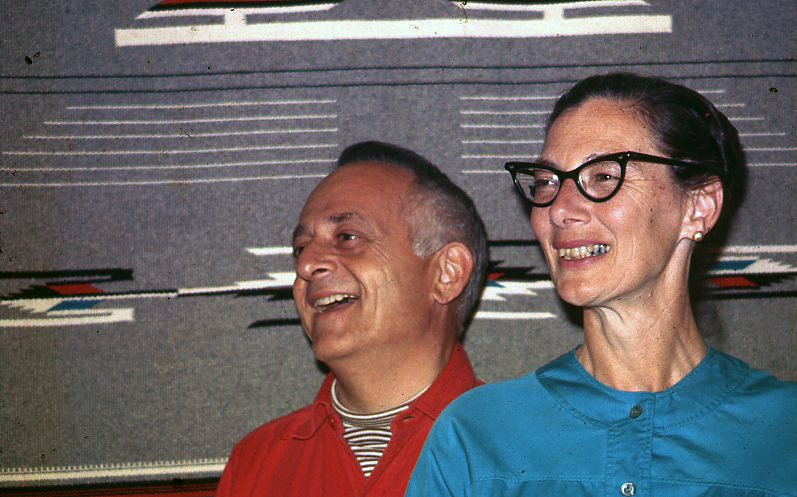
What I do find hope in is this photo. Byrne and Duncan’s love lasted longer than any external validation. The grins on their faces are proof of the simple joy they found in each other and something I am incredibly lucky to have in common with Byrne. A man who is my champion. My believer. And one who makes me laugh when I would otherwise sulk.
A birthday toast for Byrne
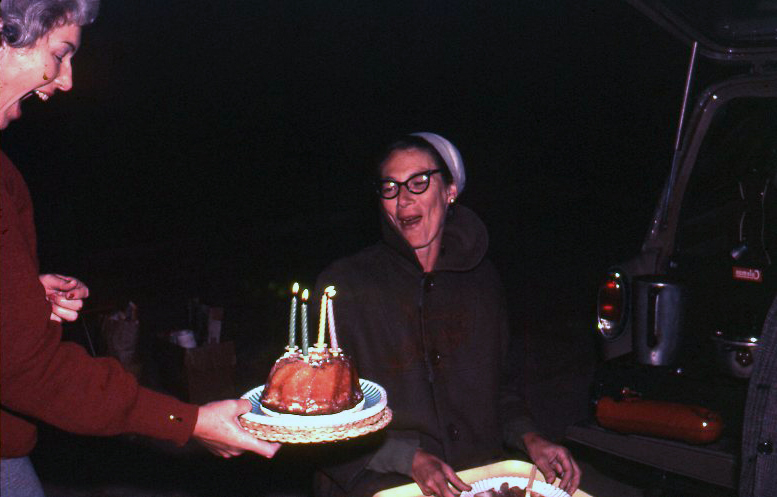
Today would have been Byrne Miller’s 101st birthday, and I’m celebrating by sharing a photograph from a birthday party long ago in Mexico. My thanks to another sister-by-Byrne, Pam Susen, who found this image in a box of slides. Byrne’s own handwriting is on the label – but all it says is Chihuahua, November 3rd. Dates never did matter to Byrne – she lived to be almost 92 and had no qualms about getting older. She never called it “aging,” but “advancing.” As in – the day I met her, she helped me carry my heavy television lights onto her porch to interview Duncan. In the book I quote her as telling me, “I am not as feeble as my advanced age implies.”
She appreciated every year she got to spend on earth – even the tough ones, after Duncan was gone. I love this photograph for the exuberance it catches – she’s thrilled that friends went to the effort, on the road, to surprise her.
So tonight, on the porch where we shared many a slice of cake and glass of wine, I invite my brothers and sisters-by-Byrne to raise a glass again at sunset. To the woman who still makes us beam. Happy Birthday Byrne!
Setting Byrne straight
What my sister-by-Byrne, Lisa Lepionka, misses most is the level of art and culture that Byrne forced on Beaufort. “The world is flat without her, Boring.” Life was never boring when Byrne Miller was around. Which is not the same thing as saying it was always easy. Byrne could be hard – on herself and others. She readily admitted she was a dance snob, and more than a few of her children know that it extended to other art forms too.
I was in my 20s when I met Byrne – she could do no wrong in my eyes and if she did, I could no more have challenged her than stop admiring her. So I cherish the memory of when I first witnessed one of Byrne’s daughters stand up to her. It was Lisa – perhaps her most devoted and tireless supporter. We were watching a hip-hop dance performance at Spoleto in Charleston. The dancers were wearing street clothes in the drab colors of camouflage.
“Not terribly imaginative,” Byrne leaned forward and whispered.
I giggled. Hip hop is perhaps my least favorite form of dance. Each time I’ve tried a hip hop class I look like Heidi on a street corner in Harlem. Not even my gymnastics training helps; I am hopeless at an art form that looks easy. Byrne’s skepticism that night at Spoleto validated my wounded pride. She was passing judgment in the dark. The pre-recorded, over-modulated music of the first dance was a cacophony. Byrne took her hearing aids out of her ears, noisily.
“That’s better,” she muttered, “muted to a dull roar.”
For the second piece the dancers wore something close to prison garb and they swaggered across the stage, grabbing crotches and flashing gang symbols.
“When will they begin to dance?” Byrne grumbled. “This is half-hearted mime.”
Suddenly the stage was pummeled with patterns of light. Blood-red graffiti scrawled across the backdrop and side curtains. The dancers stopped to read each message as it illuminated, as if demanding the audience take notes.
“This doesn’t add anything. Is he trying to distract us from the lack of movement?” Byrne complained. Her voice muscled past a stage whisper. Her irritation was audible for rows around us.
Lisa drew her chin into her neck and the arm that shared the rest between us flinched with tension. Her feet were following the rhythm of the pounding music, and her fingers tapped the beat. She was making an attempt, at least, to feel the message.
“I’ve seen enough,” Byrne declared, drawing her feet out of the aisle. “I will never invite them to perform for the Byrne Miller Dance Theatre. Let’s go.”
She was feeling around for the other end of her shoulder wrap when Lisa leaned over me and put a hand on Byrne’s arm.
“I am not leaving until the first act is over,” she said. Lisa has a thick Swiss-German accent. The measured staccato of her accent gave the declaration gravitas.
“Don’t you recognize the superficiality?” Byrne said. Her tone was somewhere between exasperation and incredulity.
“I agree it’s dreadful,” Lisa said. Byrne let out a sigh, relieved. “But there are people in the audience enjoying this performance and it shows disrespect for them to interrupt it.”
It was the longest sentence I had ever heard Lisa say and Byrne slouched back in her seat in resignation. At intermission, Byrne attempted to redeem herself.
“Shall we stay for the next half?” she asked, innocently. Lisa burst out laughing, seeing through it instantly. “I’d love to but there’s a bottle of Cabernet back at the apartment that must be close to room temperature by now,” Lisa said.
Here’s to speaking up when you need to!
One lover too many
I have two grandmothers whose memories are in varying stages of reliability. But every time one of them confuses a story, or calls me by another name, I remember one of my favorite stories about Byrne. It comes from one of my very closest sisters-by-Byrne, Lisa Lepionka.
Lisa was a tireless supporter of Byrne – she even kept tabs on Byrne’s daughter Alison until she died a few years ago. One of the many things Lisa did was help organize Byrne on concert days. Byrne herself would be juggling so many last minute details that if she didn’t have Lisa looking after her she might have arrived on stage having forgotten to dress. Not that that would have been a big thing – you’ve seen the photos of her.
One day, Lisa asked her then-teenage son Franz give Byrne a heads-up phone call, letting her know that Lisa was on her way to the house to pick Byrne up for the concert. It wasn’t until days later that she and Byrne had a chance to decompress and talk about the performance.
Lisa still laughs about it. Byrne told her “I had a lover once named Franz, and I had no idea why he called me last week.”
Cheers – to a life filled with so many lovers you occasionally mix them up.
Byrne and Yoga
This summer I took my very first yoga class, outdoors, while visiting family in Wisconsin. It seems all my friends are yoga-fanatics, yet I have always stuck to my dance guns and never experimented. It was eye-opening, the parallels astounding. And much more difficult than I imagined. Not physically, I’ve been dancing since I was a kid, but mentally. Maintaining focus, without music to transport me, is almost impossible. I found my mind wandering, to whether Byrne would have liked yoga. In some ways I’m sure she would have – getting bodies moving was always something she celebrated. Yet I know she found the part of every dance class dedicated to technique boring. A necessary evil, before the music played and improv began.
So I asked Judean about it. She’s the Savannah yoga teacher who is one of Byrne’s many adopted daughters. She thinks Byrne exemplified yogic philosophy. Especially in how stoically she coped with all her physical and health problems (the cancers, the spinal surgeries, the blood clot, the blindness)
“If anyone expressed admiration about her ability to cope she would answer “it’s just that I’m selfish and I want to be happy.” But this is really her saying that she chooses to be at peace, not dependant on outside sources for her happiness. ” She thinks Byrne’s definition of being selfish is really being self-less. “Each moment that you are happy is a gift to the rest of the world.”
I remember that Byrne too. The one who said that her mind contained many rooms. That if she found herself dwelling in an unhappy room, she moved to another room. More from Judean: “Byrne had wonderful foundational memories of being loved, but she let her life build and she evolved – she never got stuck in a place that made her miserable.”
Another concept from yoga that Judean finds parallel to Byrne is that you have to “adjust, accommodate and adapt” to change. “Love all, serve all, do good, be good. Realize.” Byrne’s way was to accommodate and adapt to changing circumstances. Like when she lost her sight. She just organized her refrigerator so that she knew exactly where everything was.
“If you go in there,” she’d say “make sure you put the orange juice back exactly to the right of the milk so I know where it is when I need it.”
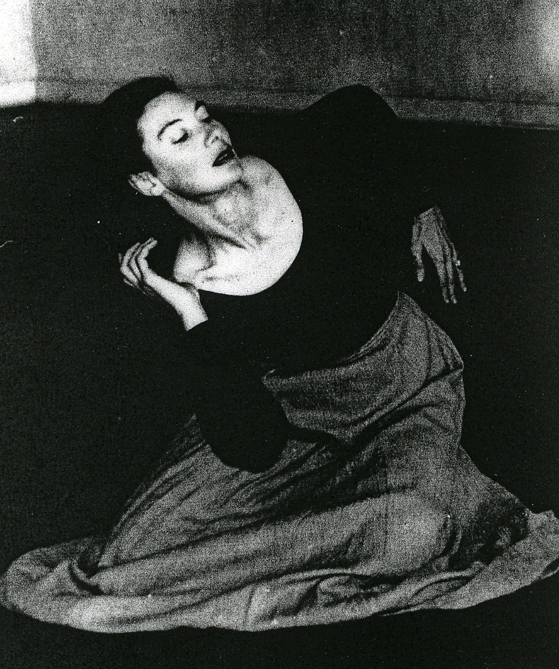
I’ve included this photograph of Byrne because it’s Judean’s favorite. “It captures the true Byrne,” Judean says. Every muscle in her body is engaged in the action. Her face is aware, the neck is taut, tendons stretched. One hand is almost limp and the other clenching. It looks like a modern floor spiral but on closer examination she is just sitting on her knees pivoting at the hip. Simple really – but the pose is so striking and strong and expressive.
“She’s so large in this picture. Every part of it is expressive. The heaviness of the head, you can tell there is weight there. The limp hand and the curled fist – a study in contrasts and complexities.” Just like Byrne.
Watching Byrne teach
I wish everyone could have seen Byrne Miller teach a dance class. Some of you did, in the video I played at the Beaufort 3 Century forum. I also have a battered old VHS copy of a master class Byrne taught in Savannah after Duncan died, but it’s too degraded to post online. Judean Drescher’s husband Joe recorded it, from the corner of the rented dance space, just letting the camera run.
Watching it, she totters forward without a cane or walker and uses her arms and hands to illustrate the concepts. This was after she had suffered the blood clot which expanded her leg to twice its normal size. So in the video she urges her bum leg forward with a swinging arm. At first it looks ungainly and awkward until I realize she is leading her legs with her arms. It reminds me of how she used to speak to that leg, telling it to bend and step and straighten – and damming it with curses when it didn’t listen to her.
She does not demonstrate how to get down on the floor, but she gives the dancers good advice. “Don’t get stuck there, push off and use the energy to rebound!” Just like she did in life.
In the video she stands with her hands on her hips, but it’s far from the familiar “Oh no you did NOT” hands-on-hip gesture we see in sit-coms. You know the one, with thumbs back, all about judgment. On the tape, Byrne’s thumbs point forward. Her long fingers are fitted against her back. If she had been shorter, it would look off balance, but her proportions allow extreme stances.
She had astounding posture. Her head was always tilted up, neck elongated, long crazy costume earrings dangling. In Joe’s videotape Byrne is completely unaware of the interruption of her long body line caused by the ugly fanny pack she wore that and every day. The fanny pack was a defiant tribute to her practicality. She just strapped it about her waist and got on with it – beautiful or not. She needed both hands free to get through life. Bravo!
Duncan’s poem
(A quick note — if you haven’t read the comments from Avant-Garde in Beaufort, make sure you check them out. My sisters-by-Byrne have the whole scoop on that wild party and the woman who threw it.)
Since so many of you loved seeing the footage of Byrne’s love, Duncan Miller, at the Beaufort 3 Century forum, I thought I’d share an idea to honor him. I never knew Duncan well. He was sliding down the slope of Alzheimer’s when I met him and I remember him mostly through the stories Byrne told. Theirs is still the best love story I have ever known. Married twice, once in secret, devoted to each other for 60 years, him watching her get dressed each day of those 60 years and telling her she was marvelous.
Byrne had very few regrets in life, but the one she shared with me is one that I hope I can erase. Duncan was a writer. A dedicated writer. One who completed six full-length novels without the reinforcing, confidence boost of publication. He kept at it, rejection after rejection. Byrne was his believer. She typed every manuscript (before computers) and every query letter to agents and publishers. She kept those manuscripts for years after his death. She felt she’d failed him – by not getting him published.
So here’s my idea. With the help of a few of my siblings-by-Byrne, and the Otram Slabess poetry group, I culled through some of Duncan’s manuscripts and pulled, from them, an assemblage. The common thread through six novels. It’s how I’ve ended my memoir. If an editor out there likes the manuscript, then Byrne would say “Duncan darling, at last you are published.”
And so, here is Duncan’s love for Byrne, drawn from lines the world rejected.
I’m hanging with my fingertips on the lip of a big idea.
I must grab hold of the earth,
or be swept away through an endless sky.
The air is so still that summer scents lie coiled close to the ground.
The palm fronds splinter and tree toads cry.
The night sobs for me.
My mind returns to those moments when I first began to know you.
Seeing through your eyes,
dancing on the edge of dreams.
I was a river coursing through your soft green banks.
We love each other for the sum of what we are.
Implicit with movement, even in repose.
Avant-Garde in Beaufort
I’ve always wondered what Beaufort’s social scene was like when Byrne Miller blew into town in the late 60s. With her wild ideas about open marriage, her comfort with nudity and all things sexual, along with her disdain for “loving hands at home”-style art, I’m sure she must have turned the town on its ear. Or did she? I found a wonderful invitation to a party she received, and saved along with all her personal papers. It was from a woman named Marion (perhaps Marion Draine, SC Arts Commission?) Anyway, wouldn’t you love to have been a fly on the wall at this event?
At Oaks Plantation, Frogmore, I am giving away some icons of November.
You are cordially invited to join in the rough draft filming of “Verna Lee’s Mater” — a ceremony of mood using 3 sculptural forms
March 30th 1-5 pm
Activity consists of leisurely gathering venus forms from a pattern on the earth; then planting in the emptied space a reflective marker.
If anyone out there went to this “event” and can dish a little – please leave a comment. If not, I’ll just take comfort in the suspicion that Beaufort wasn’t limited to cocktail parties and bridge games. Cheers!
The value of dance
I could never write a memoir about my relationship with Byrne Miller without the help of my sisters-by-Byrne: other women adopted into her extended family. Judean Drescher is a yoga teacher in Savannah, and she found her inspiration and confidence to teach through Byrne. Judean was one of Byrne’s longest-running students, suffering through cramped classes in the un-airconditioned YMCA building way back when it was a Quonset hut in Pigeon Point Park. She said what impressed her most was Byrne’s ability to create a safe place for intelligent women to express themselves physically.
“Everyone in the class was smart and accomplished. Marlene a successful architect, Lisa a teacher – but they weren’t dancers and in a typical class they would have felt insecure or compelled to compare themselves to other students,” Judean remembers. “In Byrne’s Saturday classes they found a safe harbor – didn’t have to put words together to say something important.”
She was impressed that Byrne always treated the class seriously and with respect. She loved teaching and looked forward to the moment the improvisation part of class began.
“I’ll never forget that one day, because she knew I wasn’t wealthy and that I had to drive all the way from Savannah, Byrne asked me if I needed a scholarship. She said if I did then I would have one. She didn’t say, ‘hey this is just a 3-person class so I’ll give you it for free.’ She felt proud and strongly enough about the value of her time to call it a scholarship. Even though it was a pittance that she asked as tuition.”
I know exactly what Judean means. Byrne insisted that dance has value. That all fine art does. That it is worth the price of admission. If you couldn’t afford a ticket to one of the Byrne Miller Dance Theater performances, Byrne would find a way for you to earn one. Many a young dancer ushered at the Marine Corps Air Station’s theater, or worked the phone banks for season ticket sales. World-class dance didn’t come cheap and she never dumbed it down.
When Judean organized a master class in Savannah after Duncan died, it was the nicest studio Byrne had ever taught in. Her entire career had been danced in tiny rec rooms, halls without the proper floor for dance or even mirrors. Byrne loved to teach, regardless of the circumstances. Even when amazing, world-renowned companies come to Beaufort, companies that have luxurious studios and contracts that specify facility requirements, if all Byrne had was the YMCA room in Pigeon Point Park – that’s where the classes were held. No apologies, no embarrassment, no cancellations, Judean remembers “she gave whatever she had with generosity and without apology.”
Queen Byrne’s Fiddy-cents-worth
Byrne changed her name from Bernice (so not her) to Byrne back when she began dancing. But the spelling confounded casual acquaintances for the next sixty years. So I love this little rhyme she wrote up in her journal. Add your own scratching and feedback thumps as you sing along:
Most folks learn
To call me Byrne
– It doesn’t take much tryin’
But to spell it Bryne
On list or sign
Makes me feel like cry’n’
Who knew? Byrne was a dancer and a rapper.
 "TeresaBruceBooks"